








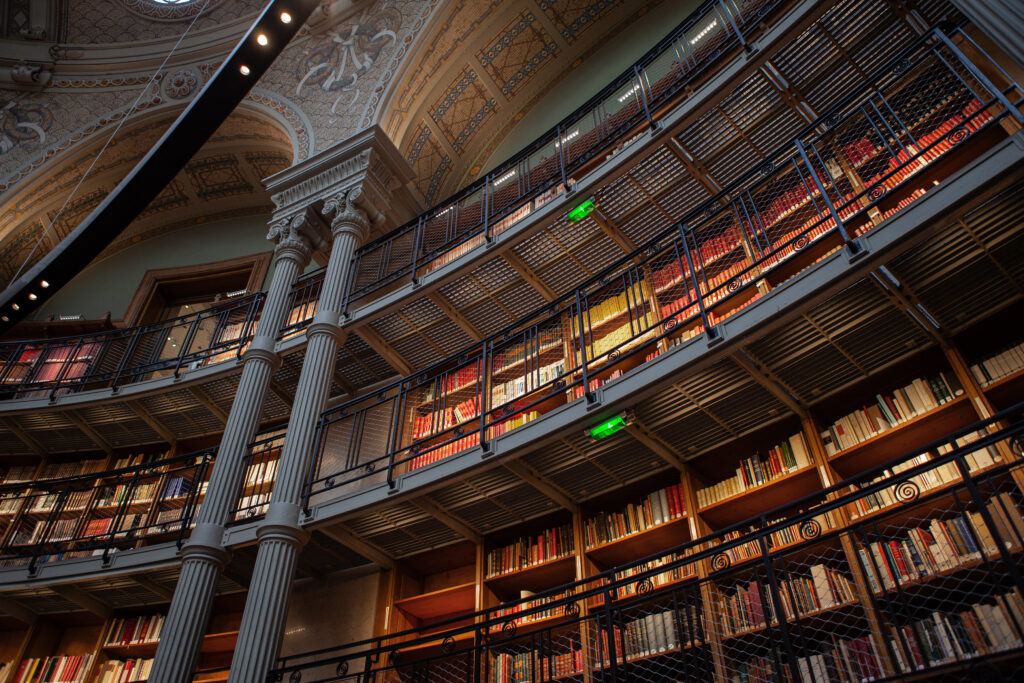
Most people only skim the Internet’s surface. What they don’t know is that beyond search engines, social media platforms, and algorithm-driven feeds lies a deeper layer built for preservation. Hidden libraries and digital archives are of the most important parts of that system. Yet, you will not find them unless you’re looking for them.
Open knowledge projects
When the Internet was still a novelty, a movement emerged to digitize human knowledge and make it freely available worldwide. That effort continues today through a collection of projects that operate with a shared philosophy: information should not be locked behind institutions, paywalls, or geography.
One of the earliest and most influential examples is Project Gutenberg. It offers tens of thousands of public domain books, from literature to philosophy, all freely downloadable. Its interface is minimal, but that simplicity reflects its purpose: endure.
More expansive, and often more surprising, is the Internet Archive. Beyond books, it preserves entire websites, audio recordings, software, and even old video games. Its Wayback Machine allows you to step back into earlier versions of the web, revealing how platforms evolved, disappeared, or rewrote their own histories. For investigators, researchers, and historians, it is an invaluable tool.
Academic knowledge
Academic publishing has long been dominated by expensive journals and restricted access. Yet parallel to that system, there is a shadow network of open repositories.
arXiv is one of the most respected. Used heavily in fields like physics, mathematics, and computer science, it allows researchers to publish pre-prints of their work before formal peer review. This accelerates the spread of ideas and creates a more transparent scientific dialogue.
Similarly, PubMed Central provides access to a vast collection of biomedical and life sciences research. For anyone working in health, cybersecurity, or data science, this is a gateway to high-quality, peer-reviewed information without subscription barriers.
Then there is Sci-Hub, a controversial but widely used tool that bypasses paywalls entirely. While its legality is disputed in many jurisdictions, its existence highlights a deeper tension between knowledge as a commodity and knowledge as a public good.
Cultural archives
Not all knowledge is academic. Some of the most fascinating archives preserve culture itself, art, music, historical documents, and ephemeral media that would otherwise be lost.
The Library of Congress hosts an extensive digital collection, including photographs, manuscripts, and audio recordings. It offers a structured, curated view of history, backed by institutional authority.
In contrast, more decentralized archives often preserve what institutions overlook. Community-driven projects document niche cultures, early Internet art, and forgotten forums. These collections can feel fragmented, even chaotic, but they capture something more raw and immediate, the lived experience of digital history.
Preserving an ever-changing environment
Today, content is constantly updated, edited, or removed. The Internet moves faster than ever. Archives provide continuity.
For investigators, they offer traceability. A deleted webpage, a changed company profile, or a rewritten narrative can often still be found in archived form. For researchers, they provide access without institutional barriers. For curious individuals, they open doors to knowledge that would otherwise remain hidden behind paywalls or obscurity.
More importantly, they shift the balance of power. When knowledge is widely accessible, it becomes harder to control narratives, restrict innovation, or gate-keep expertise.
The Explorer's mindset
Finding these hidden libraries is less about tools and more about mindset. It requires curiosity, patience, and a willingness to move beyond polished interfaces and trending content.
You follow references. You dig into citations. You explore directories that feel outdated but lead somewhere unexpected. Over time, the Internet begins to feel less like a feed and more like a landscape, one where the most valuable places are often the least visible.
There was a time when the browser was called Internet Explorer. These hidden places on the Internet were created with that mindset: surfing the Internet was active and intentional, whereas today we are fed whatever algorithms predict from our past behaviour.
The Internet’s hidden libraries are not secret in the traditional sense. They are simply overlooked, overshadowed by louder, faster, more commercial parts of the web. Yet they remain one of its most powerful features.