











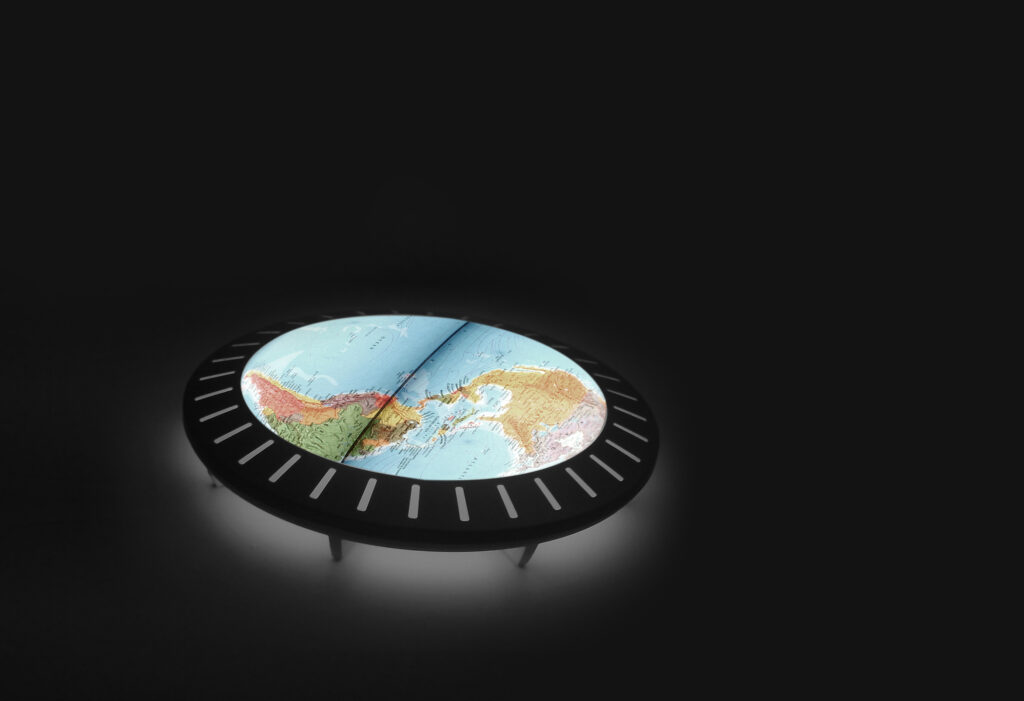
Few conspiracy theories are as visibly refuted as the claim that the Earth is flat. Centuries of astronomy, satellite imagery, navigation systems, and basic physics contradict it. And yet, in the 2010s, Flat Earth belief experienced a measurable revival, fuelled not by new evidence, but by online culture, algorithmic platforms, and identity-based distrust of institutions.
The Flat Earth movement is less about geography than it is about epistemology, who gets to define truth online.
A theory that never fully died
Flat Earth ideas never completely disappeared after the Scientific Revolution. They survived in fringe religious groups and pseudo-scientific societies such as the Flat Earth Society, founded in the 19th century.
What changed was not the belief itself, but its distribution mechanism. Before social media, Flat Earth thinking required direct social reinforcement. After YouTube, Facebook, and later Telegram, belief no longer depended on proximity, only on algorithmic discovery.
The YouTube effect
Between roughly 2014 and 2019, YouTube played a central role in Flat Earth resurgence. Users watching videos about space, physics, or scepticism were often recommended increasingly contrarian content.
Flat Earth creators framed themselves as “independent researchers”, “critical thinkers”, and victims of institutional censorship. The tone was not religious but anti-authority, positioning NASA, universities, and governments as part of a coordinated deception.
Importantly, many believers did not start by searching for Flat Earth content. They arrived there through moon landing scepticism, anti-vaccine content, and generalised distrust of experts. Flat Earth belief often functioned as a terminal conspiracy, a point at which institutional trust had fully collapsed.
Community over cosmology
Flat Earth belief persists not because it explains the world better, but because it explains alienation. Online Flat Earth groups provide a sense of belonging, shared language and symbols, and moral clarity (believers versus “sheep”).
Challenges to the theory are reinterpreted as confirmation of persecution. Scientific rebuttals become proof that the system feels threatened. In this sense, Flat Earth functions like a belief community, not a falsifiable claim.
Conferences, influencers, and monetization
By the late 2010s, Flat Earth had become an ecosystem including ticketed conventions in the US and UK, monetised YouTube channels and Patreon accounts, merchandise, books, and paid “experiments”.
Some prominent influencers admitted privately that they treated the movement as performance or income generation. For followers, however, belief often remained sincere. This dynamic created a familiar pattern seen in other conspiracy spaces: leaders with incentives, followers with faith.
Psychological drivers
Researchers studying Flat Earth communities identify several recurring traits:
- Distrust of epistemic authority, not just governments but science itself
- Pattern over evidence, personal observation outweighs collective verification
- Identity protection, abandoning the belief would mean social loss
Flat Earth belief is rarely isolated. It frequently coexists with QAnon, anti-vaccine narratives, and “sovereign citizen” ideology.
Debunking that backfires
One of the most striking aspects of the Flat Earth revival is how direct debunking often fails. Experiments conducted by Flat Earth proponents themselves, such as laser tests across bodies of water, repeatedly confirmed Earth’s curvature.
Instead of ending belief, these results were dismissed as flawed, sabotaged, or misunderstood. This reflects a broader pattern in conspiracy thinking: evidence only matters if it supports the narrative.
The Flat Earthers' migration
After 2020, Flat Earth content declined on mainstream platforms due to moderation and algorithmic changes. Many communities migrated to Telegram and niche forums.
Belief levels appear lower than their 2018 peak, but the movement’s cultural impact persists. Flat Earth became a gateway example used to illustrate how misinformation spreads, how communities radicalise, and how online identity can overpower empirical reality.
Lessons learnt from Flat Earth
Flat Earth belief is not dangerous because of its claims about geography. It matters because it demonstrates how truth becomes negotiable online, how platforms reward confidence over accuracy, and how community can override correction.
Today, facts alone are not enough.
The Flat Earth revival is not a failure of science education. It is a failure of trust, communication, and digital design.
It reminds us that conspiracy theories are rarely about the theory itself. They are about who is believed, who belongs, and who is excluded.