








We love listening to music while we work. There’s nothing like a good song playing in the background to pull out some genius from your brain and get you going for hours tapping on the keyboard. However… even if you work from home, creating that corner of paradise can be difficult. You must deal with OS-hogging apps, intrusive subscriptions, annoying ad interruptions with cringy talks and cringier jingles, and you need to count your skips in case you lose your magic momentum. When did music become so tiring?
The good ol' days
Kids today probably wonder what it was like to spend the equivalent of a one-year subscription on a couple of albums only. And then listen to the same songs over and over, instead of having access to millions of tracks at the snap of your fingers.
At the end of the 90s I was attending university in my hometown. Every other day I would stop at a tiny record store. Mixed tapes were quickly becoming obsolete: CDs were the new thing.
I would spend the little spare money I had deciding what album would be my next obsession. The record store was the place where passionate conversations happened with the shop owner and perfect strangers. I admired the artwork on the covers, some as iconic as the music. Discovering a new band you never heard about was exciting and the search for bootlegs brought a bit of transgression to the hunt.
Then MP3s took over.
The MP3 revolution
What was wrong with CDs? Nothing, except that uncompressed digital audio, such as CD-quality PCM, is large and inefficient to transmit or store. MP3, formally MPEG-1 Audio Layer III, emerged from a long research effort focused on compressing digital audio without making it unpleasant to listeners.
Researchers studied how humans actually hear sound. The encoder analyses audio and removes information that the ear is unlikely to perceive, such as frequencies masked by louder nearby frequencies and very quiet sounds that fall below the human hearing threshold.
How did they do it? The answer is efficient mathematical encoding. After perceptual analysis, the signal is transformed and compressed using a hybrid filter bank, including a modified discrete cosine transform (MDCT). Then, quantization and Huffman coding is used to reduce the bitstream size further.
The result is a file that is much smaller than the original audio while remaining subjectively close to it, especially at higher bitrates.
Initially, MP3 was intended for professional and broadcast use, not consumer music sharing. Adoption was slow until the mid-to-late 1990s, when software encoders and decoders became widely available, and the Internet bandwidth made small audio files attractive. At the same time, portable digital audio players appeared.
By the time peer-to-peer networks emerged, MP3 had become the de facto standard for digital music distribution.
Music goes digital
The creation of MP3s marked a turning point in the world of music and copyrights. Lossy compression reshaped how media files are stored, transmitted, and consumed. It also directly influenced later formats such as AAC and Ogg Vorbis.
MP3’s small file size made it ideal for the Internet of the time: a song shrank from ~40 MB (in WAV format) to ~3–5 MB as an MP3. Dial-up and early broadband could realistically transfer music sized that small. Peer-to-peer sharing platforms like Napster, Gnutella, and later Kazaa, started to pop up online. At the same time, music became detached from albums, packaging, and physical ownership.
Culturally, this was a rupture. Music turned into data that could be copied endlessly, challenging the existing business model of record labels. By the 2000s, MP3 enabled carrying thousands of songs in your pocket in an Apple iPod. Music libraries became file-based and users started to pay for listening to that file, mediated by centralized platforms.
From ownership to paid access
Owning a music album became a thing of the past. Today, music no longer needs to be stored locally. Buffering and adaptive bitrate streaming have replaced full downloads. Codecs have evolved, but the MP3 mental model remained.
Music is continuously available as a catalogue, but is algorithmically curated rather than personally owned. You pay to listen to music, but it’s never really yours. The pride of showing off your collection is no longer there, as it is hostage of a subscription and constant upgrades to eliminate nuisances from your listening experience.
Listening to music is just accessing another account that someone can use to stalk you, track you, market your data, and ultimately hack you.
Together with the unnecessary bits and its body, has music also lost its soul?
Back to an analogue experience
The seed was planted at least a decade ago when I was working in Belfast (UK). We were close to Christmas and a colleague was researching turntables as a present. At that time it sounded odd and old-fashioned, but it I thought it was such a cool idea.
Fast forward to Canada. One Sunday morning, I was looking for a restaurant in a small countryside town in Ontario, and I stopped asking for information at a local outdoors market. Then, I saw them: boxes and boxes of “old” vinyl records on a table, sold at ridiculous prices (1$-2$ each).
I spent the next 2 hours rummaging through them and finding all sort of treasures. Some were scratched and in dubious conditions, but they let me try them out at a store nearby that had a turntable. It was one of the most exciting days I’ve had in years.
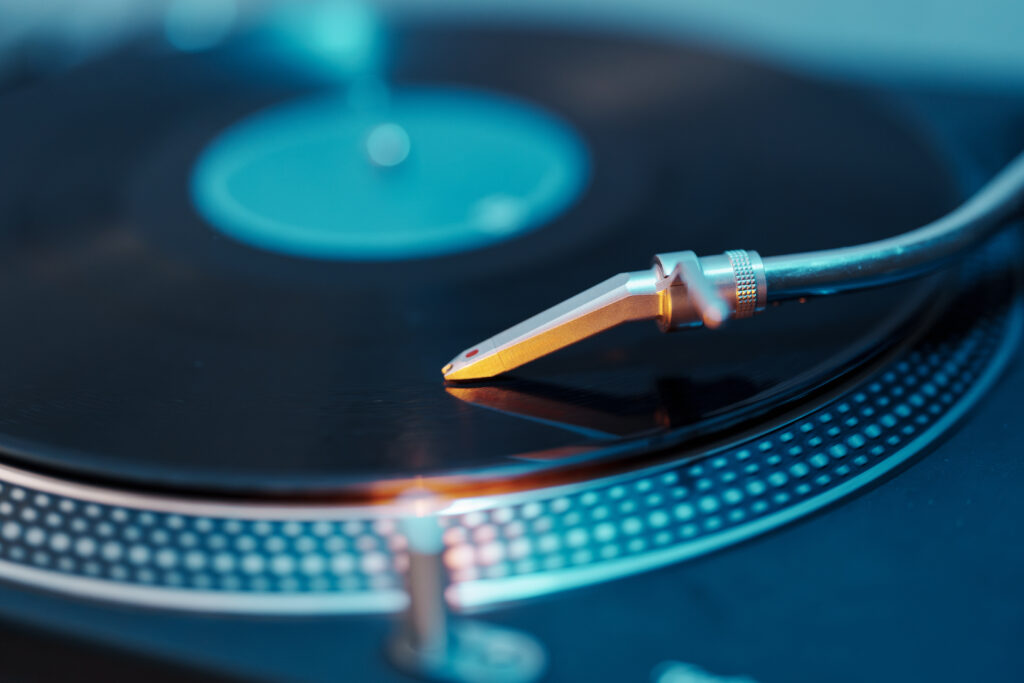
That. The experience. The thrill of finding them. The unmistakable sound of the stylus touching the disk and the wait for the music to start playing. I had the goosebumps.
When was the last time I felt like that listening to a song online? It just doesn’t compare.
Back to an analogue experience
Slowly, I found out I’m not such an odd duck. When we moved to Tenerife, we happened to be invited at a friends’ house. We discovered that they have a huge vinyl collection. After that, I started talking to another friend back in Italy, and found out that she had started collecting and exchanging vinyls too.
So how is it that so many people are reverting back to analogue? Why do people prefer buying vinyls, even at a full price, than paying for a much cheaper music subscription?
It turns out that the vinyl market is all but dead. Many artists still produce vinyl disks, and behold: they’re cooler than ever. The disks come in all sort of colours, they’re bright, they’re quirky, they have wonderful covers that you can touch and smell, and display in your home like works of art.
You put one on and… hey, no ads! You can listen to your damn song or skip one track as many times you like. You can immerse in it, experience it, touch it, and just enjoy the moment. And you can share the experience with other people (ain’t that crazy? you’re no longer the loner with a headset in the room). It’s simple, uncomplicated, beautiful.
More than music fatigue
The fatigue of digital subscription-base entertainment doesn’t stop at music. Think of the big revival of Polaroid cameras.
After all, when you take a picture with an iPhone, people can diagnose your skin by zooming in.The more powerful cameras become, the less attainable perfection is. So people use filters to hide the defects, and AI to change appearance. Rather than enjoyment, it’s a lot of stress and self-doubt.
And let’s be honest. Nobody ever goes back years on their Facebook history to re-live the moment they ate a poke bowl. Stalkers will do that, not your friend or family. So now we have apps that help you get your digital memories on print or paper albums.
This change is not generational. The fatigue of digital life is real: when the technology allows the monetization of every aspect of your human experience, maybe this trend of simplicity and privacy is not so bad, after all.