












When choosing a web hosting provider for your website, cost is often a primary consideration in the evaluation process. Many businesses also favour local providers to keep their data within their country. GDPR is enforced in all the EU member states, providing a baseline for data protection. This also means that providers can store their data anywhere GDPR applies without additional measures. So, you might choose a hosting service in France, but your data is really hosted on a server in Greece. In this article, we’ll explain why it matters.
What is a web hosting service?
- Web hosting involves storing website files on servers accessible via the internet. A web hosting service provider offers the facilities required for customers to create and maintain a site and makes it accessible on the World Wide Web. Companies providing web hosting services are sometimes called web hosts.
In Europe, companies often seek local or regional hosting for compliance with EU regulations and data sovereignty concerns.
GDPR compliance and data residency
The General Data Protection Regulation (GDPR) applies to all businesses handling EU citizens’ data, even if the hosting provider is outside the EU. Hosting with a European provider ensures data remains in a jurisdiction where GDPR is enforced.
Data residency refers to where the data physically resides (the server location). Companies may choose a provider based on the national cybersecurity laws, data access by foreign governments, and local enforcement transparency.
Types of hosting
Companies may choose different types of hosting on a server based on their needs and budget:
- Shared hosting is cost-effective, but less secure.
- VPS (Virtual Private Server) is a mid-tier solution that offers better isolation.
- A dedicated server offers full control and is best for security.
- Cloud hosting is scalable, but its security highly depends on the provider's infrastructure and data transfer practices.
What are the safest countries in Europe for hosting?
If you don’t have data residency requirements for your website, you might consider hosting in the following countries:
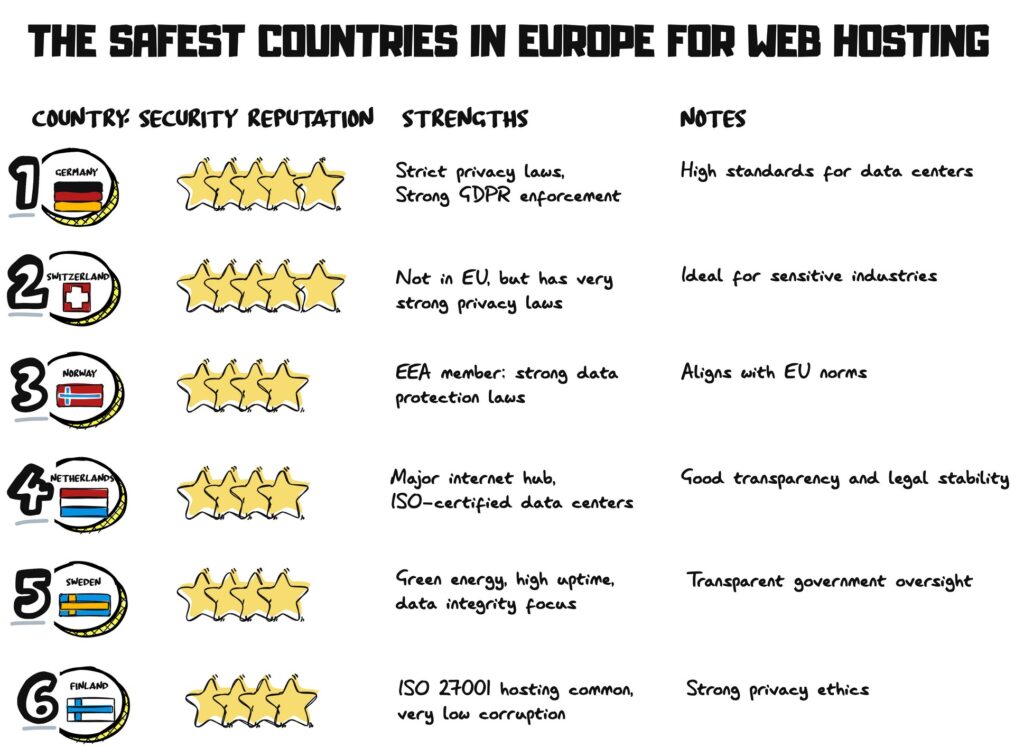
- After Brexit, the UK is no longer under GDPR but has an "adequacy decision" (as of 2025). The UK is also one of the "Five Eyes Countries".
Data stored or transmitted through infrastructure located in, or owned by companies based in, the United States or other Five Eyes countries can be subject to government surveillance or legal access requests, often without notification to data subjects or data controllers.
What are the Five Eyes countries?
The Five Eyes is an international intelligence-sharing alliance between:
- United States
- United Kingdom
- Canada
- Australia
- New Zealand
These countries have formal agreements to share surveillance data and often bypass national legal barriers via international cooperation.
Hosting data in or by companies based in these countries (even if their servers are in Europe) may expose data to laws like the US CLOUD Act (which forces US-based companies to provide data stored overseas), bulk surveillance programs (like, PRISM), and secret warrants or national security letters, often without transparency or the right to appeal.
In other words, if you’re GDPR-compliant, data residency isn’t enough if the cloud/hosting provider falls under non-EU jurisdiction.
European providers with unclear data residency
Some European providers, although GDPR-compliant, might take advantage of the freedom they have to host your data within the GDPR countries to reduce costs. Your data is still within the EU, so how does that affect you and your website?
Let’s say that an Italian provider hosts your website in Romania. Both Italy and Romania are EU member states. GDPR still fully applies, so cross-border hosting within the EU is legal under GDPR, without additional safeguards (for example, no SCCs are needed).
While the data controller (likely the Italian company) holds legal responsibility, data access laws in Romania could still come into play in case of law enforcement requests, national intelligence agency surveillance, or emergency powers invoked for public safety or national security. For example, Romania may allow government access to infrastructure under certain laws, especially if hosted at a multi-tenant provider.
From a cybersecurity perspective, server and security standards in the hosting country might differ from Italian standards. Furthermore, cross-border hosting may introduce longer support chains (the Italian provider relies on a Romanian subcontractor), less direct control over physical security or monitoring, and risks from data in transit if replication or CDN is used (especially if using unencrypted or misconfigured channels).
- Under GDPR, the data controller (in our case, the Italian provider) must inform customers of where their data is physically stored. They must have a data processing agreement (DPA) with the Romanian host and be ready to provide audit trails and access logs. Many businesses don’t realize this: failure to notify clients of sub-processing or foreign hosting may violate GDPR, even inside the EU.
How to choose the right hosting provider
So how can you find a safe hosting provider that will ensure your data privacy? Here are a few guidelines to help you make that choice:
- Data sovereignty: make sure that your web host is a European-based company. Confirm where the physical servers are located. Ask for data flow maps if using CDN or cloud layers.
- Certifications: look for ISO 27001 for Information security, SOC 2 Type II for security controls and Tier III/IV Uptime Institute certifications.
- Transparent policies: does the provider share how they handle government requests for data? Do they support zero-knowledge or encryption-at-rest?
- Juirisdiction: avoid hosting where data can be seized by foreign powers (e.g., under US CLOUD Act). Prefer jurisdictions with no forced data decryption laws.
- Open source and auditability: support providers who use open standards and auditable software stacks.
Hosting providers we recommend:
Switzerland:
Sweden and Finland:
- Bahnhof
- UpCloud
Extra security tips
When you have chosen your web host, make sure to apply the following security checks: implement full-disk encryption, use reverse proxies or DDoS protection layers (like Cloudflare EU routing), enable multi-region backups, but ensure they are still within compliant zones, and ensure that you have root access, SSH key management, and custom firewall rules.
Hosting doesn’t need to be a headache. Make sure that you know where your data is stored and make an informed decision to avoid future surprises!