









Social media platforms are constantly evolving. Over the last twenty years, their panorama has drastically changed: popular platforms like Friendster, Hi5, Orkut, and MySpace are now just a distant memory. So where have all the people gone? What platforms do they use and for what purpose? If you feel like you can’t find your way around the web anymore, you’re not alone. Here’s a map to help you understand the origins of social media and where they’re heading.
What social media used to be
Only twenty years ago, the social media panorama was divided into a few main areas:
- General networking: platforms like Friendster, Hi5, Orkut, and MySpace were mostly about connecting with friends and building personal profiles.
- Blogging and forums: LiveJournal, Xanga, Blogger, Usenet, and phpBB forums were long-form writing spaces, dominated by discussions.
- Early professional use: LinkedIn was just starting, focused narrowly on resumes and job connections.
- Community-driven groups: these were smaller, topic-based forums and flourishing niche communities.
The primary purposes for users to be on social media were self-expression (through blogs and personal pages), staying in touch with friends, experimenting with identity (using avatars and nicknames), and building smaller niche interest groups.
A social media map of today's networks
Today’s social media panorama is more complex and fragmented. Not only has the purpose changed, but also the ways people express themselves have changed:
Professional and knowledge-sharing communities
- LinkedIn → professionals, B2B, job seekers, recruiters
- ResearchGate, Academia.edu → academics, researchers
- Stack Overflow, GitHub → developers, technical communities
Visual storytelling and lifestyle communities
- Instagram → younger audiences, influencers, lifestyle branding
- Pinterest → hobbyists, DIY, design inspiration, majority female user base
- VSCO, BeReal → creative teens and young adults, authenticity over curation
Long-form and community-driven videos
- YouTube → all demographics, education, entertainment, vlogging
- Twitch → gamers, streaming communities, mostly 16–34 years old
- Kick (emerging) → alternative to Twitch, younger/gamer audiences
Text and discourse-heavy communities
- X (Twitter) → journalists, activists, fandoms, real-time news
- Threads (Meta) → casual conversation, Instagram crossover users
- Reddit → anonymous communities, niche interests, knowledge-sharing
- Tumblr → fandom-heavy, queer and alternative culture
Messaging and private networks
Relationships and social discovery
- Facebook → aging population, family connections, community groups
- Dating apps (Tinder, Bumble, Hinge) → singles, varying by region/age
Emerging, alternative, and niche communities
- Mastodon, Fediverse → decentralization advocates, tech-savvy communities
- Truth Social, Gab, Parler → politically motivated, right-wing user bases
- 4chan, 8kun → anonymous, fringe, often controversial communities
What happened to social media platforms?
First of all, today’s social media is characterized by a massive video dominance: highly successful networks such as YouTube, TikTok, Instagram Reels, and Twitch use video as the primary form of engagement.
Content feeds are no longer chronological; rather, they are now driven by AI-generated algorithms. This means that AI curates what people see. At the same time, the focus of social media is no longer content: it’s all about branding. Even professional networks like LinkedIn have evolved into full business content hubs.
Communities of users are now fragmented into specialized spaces hosted on Discord, Telegram or Reddit forums. This makes tracking topics across different networks more difficult. Content is often ephemeral: stories and disappearing content are becoming common, promoted by Snapchat, Instagram stories, or BeReal.
Finally, more and more people are polarizing into political and ideological spaces of like-minded individuals: alternative networks such as Gab, Truth Social, and Mastodon have been created around identity or ideology.
The social media ecosystem
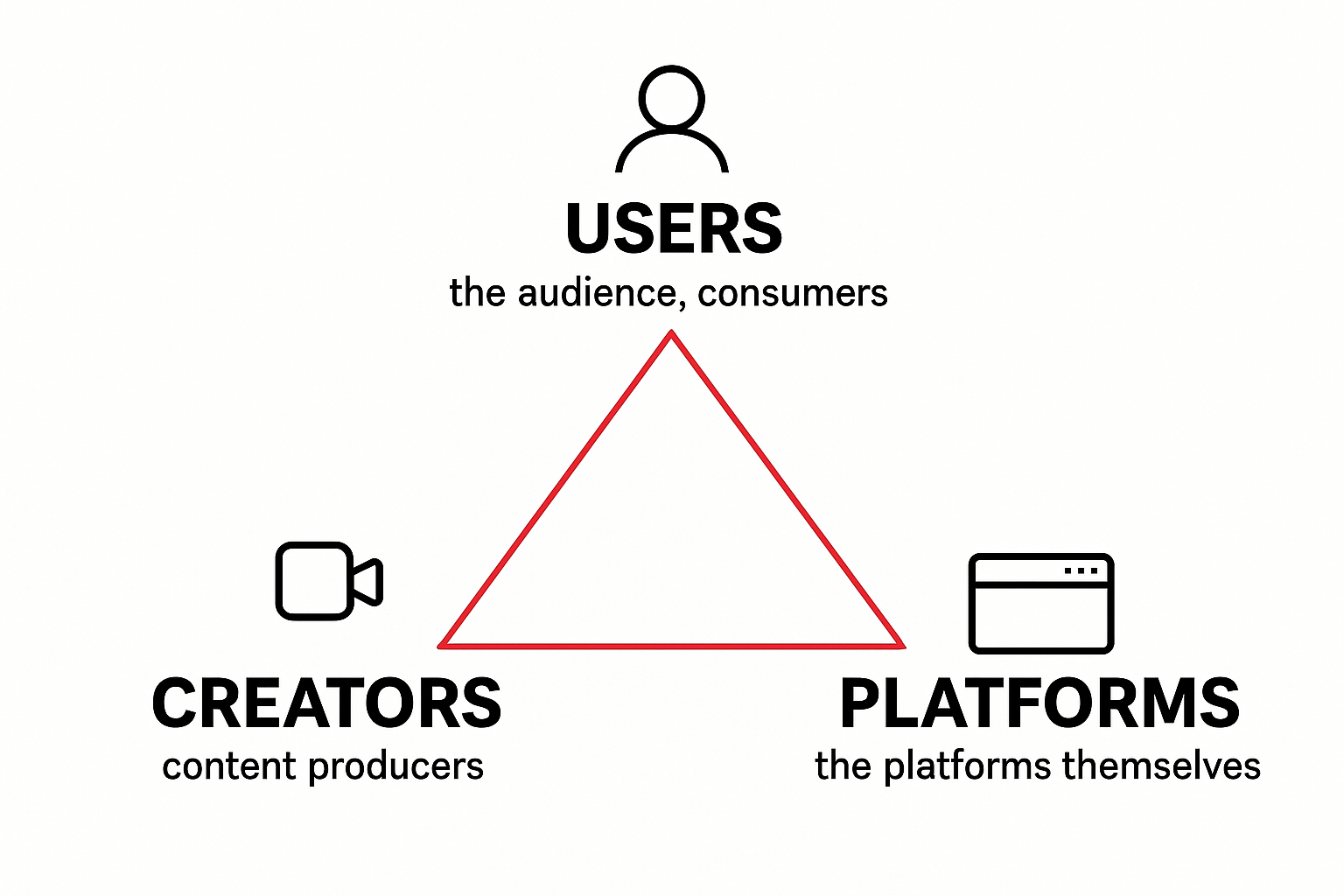
The user
Users’ role is to scroll, like, share, comment, and follow. Their motivation for being on social media varies from entertainment, social connection, information, and self-expression. Users’ behaviour is mostly passive consumption (lurkers) with occasional active engagement. Their vulnerability on social media platforms is that their data, attention, and behaviour patterns are constantly tracked and monetized.
The creator
Creators provide the fuel (videos, memes, tutorials, news) that keeps platforms alive. Their motivation for doing that is recognition, influence, and monetization (ad revenue, sponsorships, brand building). Creators adapt content to platform algorithms, trends, and monetization systems. Their vulnerability on social media is their platform dependency: their careers hinge on algorithm changes, demonetization, or bans.
The platform
Social media platforms have the role of gatekeepers. They design the algorithms, set the rules, and control visibility and monetization. Their motivation is to maximize engagement, which draws advertising revenue, which increases shareholder value.
They can do all of that in multiple ways: first, with the manipulation of their algorithms, which decide what users see (shaping opinions, moods, and behaviours). Secondly, they psychologically design their platforms: for example, infinite scrolling and notifications are mechanisms to induce FOMO (Fear of Missing Out) loops to keep users engaged. Third, they harvest data tracking user actions, infer their preferences, and sell access to advertisers. Finally, social media networks can reshape creator behaviour overnight through policy changes (e.g., TikTok bans or YouTube ad rules).
From digital commons to a markeplace
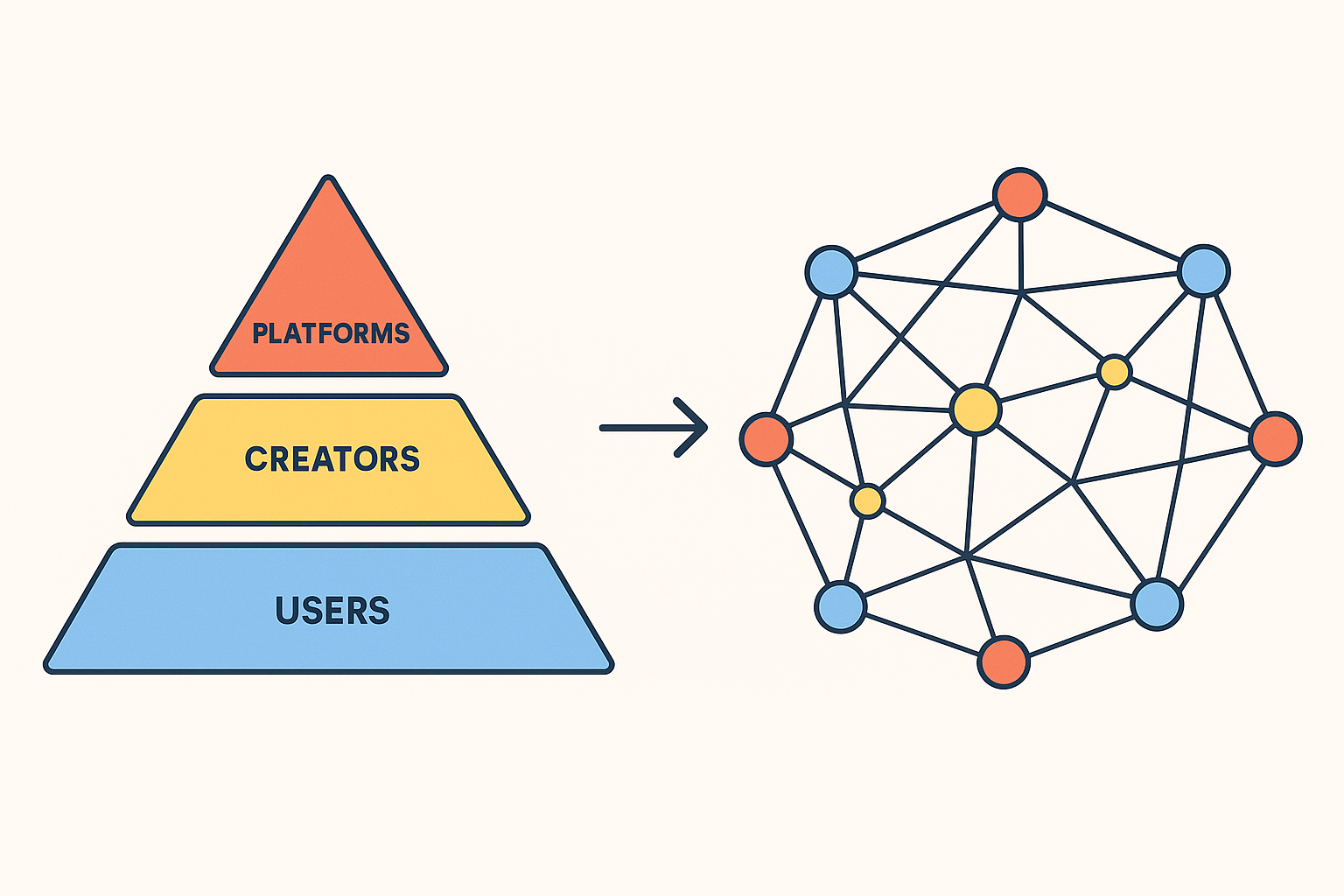
The social media ecosystem is built on tension among users, creators, and platforms: users want authentic connections and entertainment; creators want reach and income; platforms want profit.
However, these actors don’t hold the same amount of power in the game: social media platforms hold structural dominance; creators hold cultural influence (they drive trends and movements); and users, although are singularly uninfluential, hold collective leverage. Mass user migrations can kill or revive platforms, as it happened with user migrations from MySpace to Facebook, or from Twitter to Threads and Mastodon.
Today’s social media is less of a digital commons, as it was intended in the beginning, and more of a marketplace controlled by manipulators, fuelled by creators, and consumed by users.
Where are social media platforms heading?
Today’s social media picture doesn’t look as exciting as it was in the beginning. Today’s giants like Meta, TikTok, and YouTube are centralized and algorithm-driven. Future trends point toward fragmented, niche communities where users want more authenticity and less manipulation.
Users are also becoming more aware of data exploitation and manipulation. New models like Web3 social media (Lens Protocol and Farcaster) promise user-owned identities, portable followers, and monetization without relying on platforms.
The role of AI in social media
AI is already flooding platforms with synthetic content: deepfakes, AI influencers, and automated engagement are already exploiting users. This risks devaluing human creators but could also shift focus toward trusted, verified sources and smaller creator–follower relationships.
This is where governments need to take action: some governments (like the European Union with its Digital Services Act and Canada with Bill C-18) are forcing platforms to take responsibility. If regulation grows, platforms may lose some unilateral power, reshaping the “manipulator” role.
Regulating the Internet?
The Internet has been, for the longest time, an open, free, and unregulated space that offered possibilities across geographies. However, this might be the time when Governments are called to step up to protect users.
Platforms may remain powerful, but decentralization and regulation will limit their dominance. Creators may gain independence by taking their audiences across ecosystems, and users may stop being the weakest link if data ownership, digital rights, and collective action become central.