







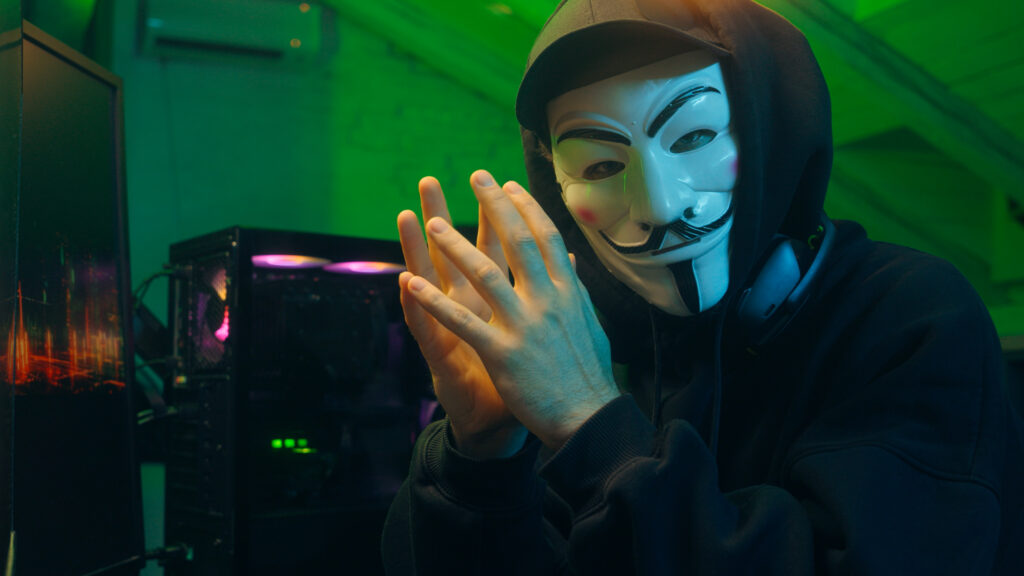
It began as a smirk. A stylized, pale face with a pointed beard and mischievous smile worn first by a comic book anarchist, then by a collective of hackers. The Guy Fawkes mask, lifted from Alan Moore’s V for Vendetta, was never meant to be a global icon. But when Anonymous adopted it, the symbol escaped fiction.
The mask that went viral
“Ideas are bulletproof.”
V for Vendetta
The Anonymous mask appeared in protests from Wall Street to Cairo, in digital avatars and press videos, in the streets and in the code. It became a shorthand for resistance, a blank face behind which anyone could hide, and through which everyone could speak.
For Anonymous, the mask was an identity and an anti-identity: protection from surveillance, but also an act of defiance. Wearing it said: I am not me. I am all of us.
From meme to movement
Before it was a cause, Anonymous was a meme. It thrived on irony, lulz, and chaos. But when the group turned its trolling skills toward power — during Project Chanology against the Church of Scientology — the mask took on new meaning.
Thousands of masked protesters marched outside Scientology centers in 2008, chanting, “We are Anonymous.” What began as a prank had mutated into digital civil disobedience. The collective had stumbled into politics and discovered its own mythology.
This was the beginning of Anonymous as spectacle: the use of humour, spectacle, and theatrical rebellion to draw attention to hidden injustices. The lulz became a weapon.
Media and mythmaking
The press helped make Anonymous famous and infamous. Headlines called them “hackers on steroids”, “cyber freedom fighters”, or “digital terrorists.” Every operation, every leak, every arrest was magnified by the echo chamber of media fascination.
Mainstream coverage turned the collective’s mystery into legend. A movement with no leaders was easier to mythologize than to define. And that was precisely Anonymous’ power: it could be anything the world needed it to be — a threat, a hero, a ghost.
“Anonymous doesn’t exist. It’s just the Internet, having an opinion.”
Anonymous member
The power of anonymity
In a world obsessed with personal brands and social media followers, Anonymous reversed the current. Its strength came from erasing individuality, a radical act in the age of surveillance capitalism. No faces. No names. No leaders.
That anonymity was both armour and a curse. It allowed global coordination without hierarchy, but it also made the movement vulnerable to infiltration, impersonation, and chaos. Still, the idea was irresistible: that a million people acting as one could challenge governments, corporations, and even reality itself.
Pop culture rebellion
From Mr. Robot to Watch Dogs, from protest art to hacker documentaries, Anonymous infiltrated pop culture like a virus of rebellion. The Guy Fawkes mask became a commodity, ironically mass-produced by corporations that the movement despised. But even that paradox felt poetic: the system selling the face of its own resistance.
Art galleries featured Anonymous imagery. Street murals appeared in São Paulo, Berlin, and Hong Kong. The movement became a mirror, reflecting each society’s own fears and fantasies about power, control, and freedom. Anonymous was no longer just a hacker group — it was an aesthetic, a philosophy, and a digital archetype.
The myth lives on
Even when operations faded and factions splintered, the symbol endured. Each resurgence, in the wake of injustice, censorship, or war, brought new voices behind the mask. The collective’s very amorphousness allowed it to survive beyond individuals or platforms.
Anonymous’s greatest hack might not have been technical at all. It hacked culture, rewriting how we see protest, identity, and power.