











The site Gab was launched in 2016 by Andrew Torba as an alternative to mainstream social-media platforms. It has since become one of the most controversial “alt-tech” networks, in part because of its minimal moderation policies and in part because of the type of communities and users it attracted.
Who is Andrew Torba?
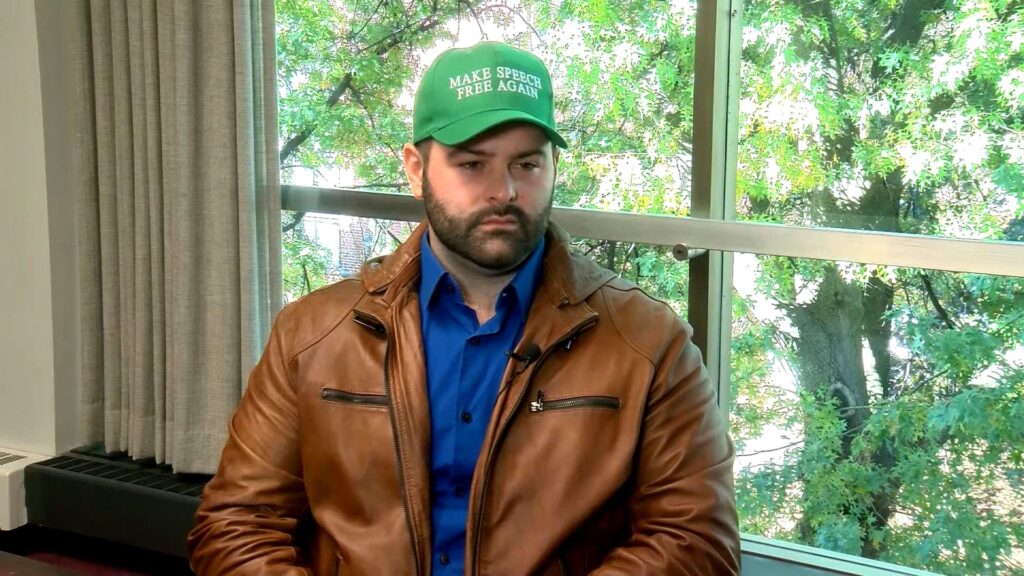
Andrew Torba describes himself as a “conservative Republican Christian.” Born in 1991, in Scranton, Pennsylvania, he has a background in Business Administration from the University of Scranton, even if some sources also mention he earned a BA in Philosophy and may have double-majored in Philosophy and Political Science with a minor in Entrepreneurship. He graduated in 2013.
Professionally, Torba co-founded Kuhcoon (later renamed Automate Ads), a social media management service, while still in college. After participating in the Y Combinator accelerator program in 2014, he went on to found Gab in 2016, a social media platform positioning itself as a free-speech alternative to mainstream networks, where he serves as CEO.
In addition to his platform, Torba has authored and co-authored several books promoting Christian nationalism, including Christian Nationalism: A Biblical Guide For Taking Dominion And Discipling Nations (2022), which became a bestseller on Amazon.
He advocates for building a “parallel Christian economy” and has called for the creation of independent Christian institutions, including banks and social media platforms.
Online politics and social media
Reportedly, Torba’s motivation to build Gab arose after he perceived what he called “social-justice bullying,” content moderation bias, and ideological homogeneity in mainstream social platforms. He has publicly argued that existing platforms had become “the Big Social monopoly,” favouring certain political leanings.
For those who felt silenced or censored by mainstream platforms (particularly those on the political right) Torba positioned Gab as a refuge for free expression.
Gab’s founding can be seen in the broader context of rising polarisation after the 2016 U.S. presidential election, when debates about deplatforming, online censorship, and echo chambers became central to digital public discourse.
What is deplatforming?
- Deplatforming refers to the act of removing or banning an individual, group, or entity from a digital platform, particularly social media or online forums, thereby preventing them from sharing their views or content.
Deplatforming is commonly used as a form of content moderation to enforce community guidelines, especially in response to hate speech, disinformation, coordinated inauthentic behavior, or incitement to violence.
The term has evolved from the historical practice of “no-platforming,” which involved preventing controversial speakers from appearing at physical events, but has become significantly more impactful in the digital age due to the widespread reach of online platforms.
Deplatforming can involve the suspension of accounts, deletion of content, or the denial of access to infrastructure services, and it is often implemented by major tech companies in response to public pressure or policy violations.
What are echo chambers?
- An echo chamber in social media refers to an environment where individuals are primarily exposed to opinions and beliefs that reinforce their own, while opposing viewpoints are systematically excluded or discredited.
This phenomenon occurs when users interact predominantly with like-minded peers or information sources, leading to the amplification and repetition of shared views within a closed, insulated system. The term is a metaphor derived from an acoustic echo chamber, where sounds reverberate and are amplified within a confined space.
The early days of Gab
Gab was launched in August 2016 as a private beta and then publicly opened in May 2017. At its core Gab was designed to resemble a hybrid of microblogging and social networking, a blend of Twitter and Reddit in structure.
Torba and his team positioned Gab as a “free speech first” network, claiming to embrace the free flow of information under U.S. law rather than implementing heavy content moderation. Initial growth was rapid, in part driven by users who felt deplatformed on mainstream networks for controversial views. As early as 2017 Torba claimed the site had hundreds of thousands of users.
Gab’s user base included a mix of conservatives, libertarians, and others who felt mainstream platforms censored them, but also users from alt-right, extremist, and conspiracy-oriented backgrounds.
Content and controversy
From early on, Gab’s minimal moderation policy set it apart. In public statements Torba said the site would apply “U.S. law” rather than create additional restrictions, meaning that as long as content wasn’t illegal, it was allowed.
Scholarly work analysing Gab’s early data (2016–2018) found that the platform indeed attracted alt-right users, conspiracy theorists, and others banned from mainstream platforms. One study based on millions of posts found that Gab’s rate of hate speech was substantially higher than on Twitter, though lower than on some anonymous image-boards.
Users on Gab engaged heavily in political discussions, news sharing, conspiracy theories, and extremist content. Some of the most nodal topics in research samples included Holocaust denial, conspiracy rhetoric, anti-immigrant discussions, and distrust of mainstream media.
Torba has personally promoted antisemitism, conspiracy theories, and right-wing extremist ideologies on his network and other platforms like Telegram.
The Pittsburgh shooting
Gab attracted international scrutiny following the 27 October 2018 mass shooting at the Tree of Life synagogue in Pittsburgh. The alleged gunman appeared to have used Gab to post violent, antisemitic messages just before carrying out the attack. In the aftermath, several infrastructure providers cut ties with Gab: domain registrars and hosting services, payment processors, and app stores distanced themselves. This forced Gab to seek alternative hosting and fundraising solutions.
This episode cemented Gab’s reputation in media and civil-society reports as a haven for hate speech, extremist rhetoric, and radicalisation, despite Torba’s repeated claims that Gab simply allows free speech.
Gab's evolution
Despite the backlash, Gab continued operating. The company expanded its services: offering chat (encrypted messaging), video content, and “alternative” monetization strategies due to restrictions from mainstream payment processors.
Over time, Gab sought to position itself more broadly as part of the “alt-tech” ecosystem appealing to those who felt mainstream networks suppressed certain political or cultural views. Despite the setbacks, Torba has continued to expand the platform, which now includes services like Gab AI, Gab News, Gab TV, and a browser extension called Dissenter. As of 2022, Gab had an estimated 5 million total users and 100,000 active users.
Academic analyses of Gab’s network structure identified patterns typical of echo chambers: limited cross-ideological exposure, clusters led by highly influential users, and bursts of activity often tied to external political events.