











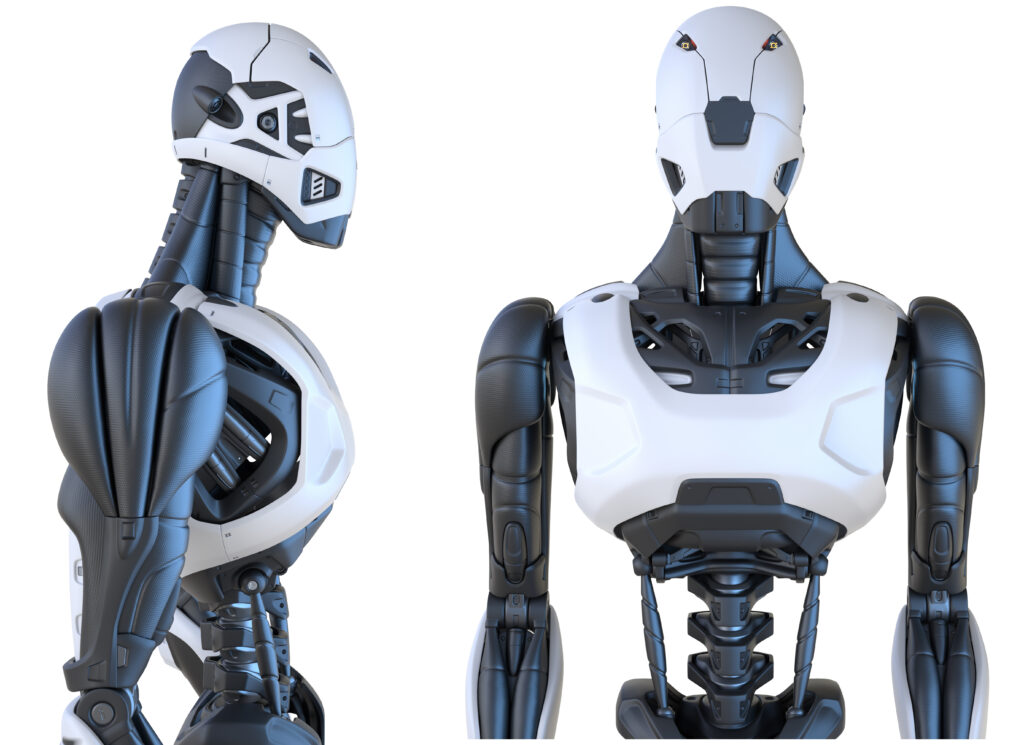
Humanoid robots are the most recognizable, publicized, and often the most misunderstood in robotics. Designed to resemble the human body in structure and movement, these machines promise a future where robots can seamlessly integrate into environments built for people. But can they?
Why build robots that look like humans?
At first glance, humanoid robots seem inefficient. Wheels are faster than legs, specialized machines outperform general-purpose ones, and industrial robots already dominate controlled environments.
So why pursue a human form?
The answer lies in infrastructure. The modern world is designed around human capabilities. Stairs, door handles, tools, shelving systems, and vehicles all assume a certain height, reach, and dexterity. A robot that mirrors these characteristics can, in theory, operate without requiring the environment to be redesigned.
Companies like Agility Robotics are leveraging this idea, developing bipedal robots capable of working in warehouses where layouts are optimized for human workers rather than machines.
The key players and their approaches
The race toward humanoid robotics is being driven by a mix of startups and major technology companies, each with different philosophies.
Boston Dynamics focuses on mobility and balance, producing robots that can run, jump, and recover from disturbances with remarkable stability.
Tesla
Honda
Honda, known for its earlier ASIMO robot, explored human-like interaction and mobility long before the current wave.
Despite different approaches, the goal is similar, creating machines that can operate in dynamic, human-centric environments with minimal supervision.
The engineering challenge
Humanoid robots are among the most difficult systems to build. Walking on two legs, something humans learn early, is a complex problem in robotics. Maintaining balance requires constant adjustment based on sensor input and environmental feedback.
Dexterity is another major hurdle. Human hands are capable of fine manipulation, from typing to handling fragile objects. Replicating this level of control in a robotic system remains an open challenge.
Then there is energy. Humanoid robots consume significant power, especially when walking or performing physical tasks. Battery limitations restrict operational time, making them less practical than wheeled alternatives in many scenarios.
These constraints explain why, despite decades of research, humanoid robots are still not widely deployed at scale.
From demos to deployment
One of the defining characteristics of humanoid robotics is the gap between demonstration and real-world use.
Videos of robots performing backflips or navigating obstacle courses are impressive, but they often occur in controlled conditions. Real environments introduce unpredictability, uneven surfaces, variable lighting, human interference, and unexpected obstacles.
This is where many systems struggle.
Even advanced robots from Boston Dynamics, while highly capable, are typically deployed in specific, controlled scenarios rather than open-ended environments. Similarly, prototypes from Tesla have yet to prove consistent performance outside staged settings.
The transition from controlled demonstration to reliable deployment remains one of the biggest barriers in the field.
Use cases
Current and proposed applications for humanoid robots fall into several categories:
- Logistics and warehousing: humanoid robots can potentially replace or assist workers in environments designed for human movement, lifting, carrying, and sorting items.
- Manufacturing support: instead of replacing industrial robots, humanoids may complement them by handling tasks that require flexibility and movement between stations.
- Retail and customer interaction: some companies explore humanoids for front-facing roles, though reliability and social acceptance remain challenges.
- Hazardous environments: disaster response, nuclear facilities, and other high-risk areas are often cited as ideal use cases, though practical deployments are still limited.
In many cases, these applications remain aspirational rather than operational.
The hype cycle
Humanoid robots attract attention because they align with cultural expectations shaped by decades of science fiction. This visibility can create a disconnect between perception and reality.
Investments are increasing, and prototypes are improving, but widespread adoption depends on cost, reliability, and clear return on investment. A humanoid robot must outperform simpler alternatives to justify its complexity.
This is where many projects stall. In logistics, for example, wheeled robots often provide a more efficient and cost-effective solution. The humanoid form only becomes advantageous in environments where redesigning infrastructure is impractical.
Human interaction: familiarity or discomfort?
Humanoid robots introduce a psychological dimension that other machines do not. Their human-like appearance can make interactions more intuitive, but also more unsettling.
The concept of the “uncanny valley” describes the discomfort people feel when something appears almost human, but not quite. Designers must balance realism with acceptability, ensuring that robots are approachable without triggering unease.
This challenge becomes more pronounced in roles involving direct human interaction, such as customer service or care.
Are humanoid robots the future?
In environments built for humans, humanoid robots offer a compelling vision. They could reduce the need for specialized infrastructure and enable automation in spaces that are currently difficult to mechanize.
However, they are unlikely to replace all other forms of robotics. Specialized machines will continue to dominate tasks where efficiency and simplicity matter more than adaptability.
Humanoid robots are not the universal solution. They are one branch of a broader robotics ecosystem.
Looking ahead
The rise of humanoid robots highlights both the ambition and the limitations of modern robotics. They represent a push toward general-purpose machines capable of operating in the same world as humans, but they also expose the complexity of that goal.
Next week, we’ll shift focus from form to intelligence, exploring how artificial intelligence is giving robots the ability to perceive, learn, and make decisions in increasingly complex environments.