











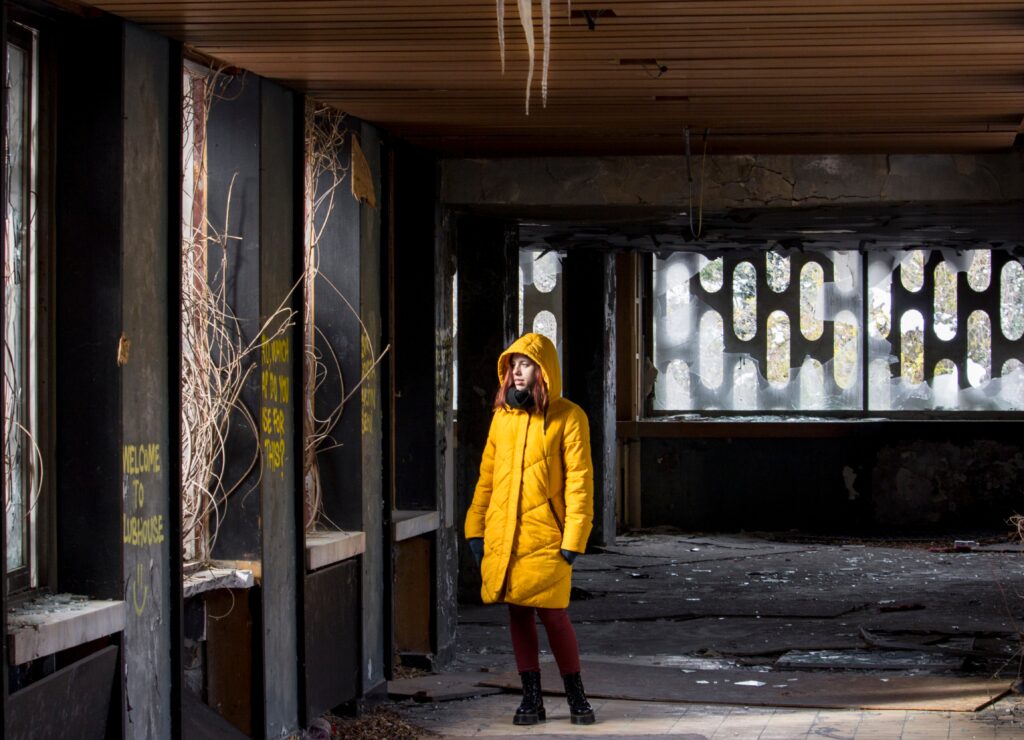
There is a particular kind of image that circulates online with persistent intensity: a decaying hospital corridor swallowed by vines, a theatre balcony layered in dust, a control room frozen mid-century with switches and dials intact. No people, no movement, only the residue of human intention. These images are often the work of urban explorers, commonly called “urbex” communities, who seek out abandoned, off-limits, or forgotten spaces and document them.
Urban exploration is not new. What is new is the scale, visibility, and aesthetic coherence it has acquired through the internet. Today, urbex sits at the intersection of photography, digital storytelling, risk performance, and platform culture. It is part archaeology, part trespass, part art, and part online identity.
To understand urban explorers is to understand how digital culture has reshaped our relationship to decay, danger, and memory.
Entering the in-between
Urban exploration generally involves entering disused or restricted sites, such as abandoned factories and warehouses, decommissioned hospitals or asylums, closed schools and office buildings, underground tunnels and infrastructure, rooftops, cranes, and high-rise construction sites, transit systems and utility corridors.
Participants often operate under an informal ethic: “take nothing but photos, leave nothing but footprints.” Whether universally followed is another question, but the phrase reflects a desire to frame the activity as documentation rather than vandalism.
The spaces explored share a common quality. They are not yet demolished, but no longer maintained. They exist in a legal and symbolic grey zone. Urbex participants are drawn to this liminality, the sense of standing inside suspended time.
Ruins in the age of platforms
Before the internet, urban exploration was largely local and niche. Online forums, then imageboards, and later Instagram, Flickr, and YouTube transformed it into a global visual genre.
Platforms did three things: they standardized the aesthetic, they increased visibility and competition, and they accelerated location discovery and replication.
Images of peeling paint, rusted machinery, and sunbeams cutting through broken windows became recognizable visual codes. Algorithms began to reward high-contrast, dramatic shots. The more cinematic the ruin, the more likely it was to circulate.
As a result, abandoned spaces became content assets.
The aesthetics of abandonment
Urban exploration overlaps heavily with digital aesthetic cultures such as liminal spaces and decaycore. Certain motifs recur:
- Symmetry disrupted by collapse
- Nature reclaiming built environments
- Institutional spaces emptied of authority
- Objects left mid-use, implying sudden departure
These images evoke more than visual interest. They suggest societal fragility, economic shifts, and institutional failure. An empty shopping mall is not merely architectural. It is commentary on consumer cycles. A derelict hospital implies both budget cuts and mortality.
Urbex photography transforms infrastructure into narrative.
Risk as performance
Urban exploration involves legal and physical risk. Trespassing laws vary by jurisdiction, but many sites are technically off-limits. Physical hazards include unstable floors, exposed wiring, toxic materials, and structural collapse.
Online, risk becomes part of the performance. Rooftopping and crane climbing, particularly in major cities, are documented as feats of courage and skill. Height, proximity to authority, and exclusivity increase social capital.
The internet amplifies this dynamic. The more dangerous the location, the more viral the potential image. In this way, platform incentives can push exploration toward escalation.
Secrecy and disclosure
One of the most contested issues within urbex communities is location disclosure. Many explorers avoid publicly naming sites to prevent vandalism, theft, or overexposure. Others share coordinates openly, accelerating cycles of discovery and destruction.
The pattern often unfolds as follows:
- The site is discovered and quietly documented
- The images circulate without metadata
- The location eventually leaks or is reverse-engineered
- The location is subjected to increased traffic, vandalism, or law enforcement attention
- The site is sealed, demolished, or destroyed.
The tension between documentation and preservation defines much of urbex culture. Visibility both validates and endangers the practice.
Memory, preservation, and digital archives
Urban explorers often see themselves as informal archivists. They capture spaces before redevelopment erases them. In post-industrial regions, this includes factories tied to generational employment. In rapidly growing cities, it may involve neighbourhoods awaiting demolition.
In this sense, urbex functions as a counter-archive to official narratives. Governments and developers document new construction; explorers document decline.
However, digital archives are also fragile. Platforms change policies, accounts are removed, metadata disappears. The preservation of abandonment depends on corporate infrastructure.
Ethical and legal ambiguities
Urban exploration exists within layered ethical terrain:
- Trespassing may violate property rights
- Entry into unstable buildings risks emergency services intervention
- Public exposure of sites may enable looting
- Documentation can romanticize decay without addressing the causes.
The social dimension
Despite the solitary imagery, urban exploration is frequently collaborative. Small groups coordinate entry, monitor surroundings, and share techniques. Online forums exchange advice on safety, legal considerations, and gear.
Trust is central. Access routes and site conditions are sensitive information. Communities form around shared discretion.
This creates a paradox. Urbex is visible online, yet dependent on secrecy offline.
Urban exploration and broader cultural mood
The popularity of urbex imagery corresponds with broader cultural anxieties: from deindustrialization and economic displacement to housing crises and speculative vacancy, and also climate-related infrastructure failure, and the pandemic-era emptiness of the public space.
Abandoned spaces mirror fears of systemic instability. They also provide a controlled way to engage with collapse, contained within the frame of a photograph.
The ruin becomes a manageable version of societal uncertainty.
The social media escalation curve
As with many other online subcultures, platform incentives reshape human behaviour. When simple abandoned buildings no longer attract engagement, more extreme content gains traction: that’s when influencers escalate to active construction site infiltration, high-altitude free climbing, international “forbidden place” tourism, or nighttime infiltration for dramatic lighting.
Escalation increases risk exposure. Visibility transforms a niche hobby into a performance economy.
Ruins as a reflection
Urban exploration is not simply about trespassing or photography either. It is about standing inside structures that once promised permanence and discovering their fragility. Abandoned spaces offer unfiltered texture. The appeal lies in touching something unscripted.
The internet has transformed these encounters into shareable artifacts, amplifying both their beauty and their risk. In doing so, it has turned decay into narrative, and narrative into social currency.
Urban explorers document the margins of infrastructure. In their images, we see abandoned buildings, and also the uneasy relationship between memory, visibility, and the platformed gaze.