











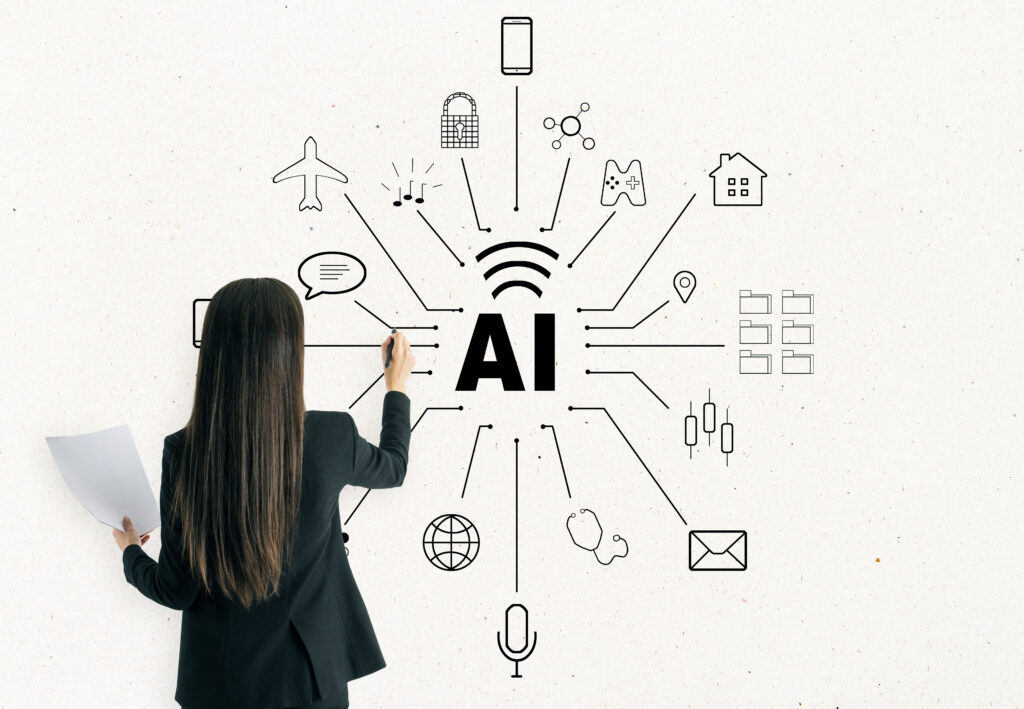
AI is no longer confined to research labs or sci-fi scenarios. It is embedded in our daily lives, influencing how we communicate, shop, work, travel, and even interact online. From automated recommendations to cybersecurity systems, Artificial Intelligence has become a ubiquitous force shaping industries and individual experiences.
Everyday AI
Many AI applications operate invisibly in the background, yet they touch millions of people every day.
Personal assistants and smart devices
- Voice recognition and natural language understanding allow assistants like smart speakers and phone AI to interpret commands.
- Predictive features suggest actions, from calendar appointments to emails or navigation routes.
Example: Smartphones suggest the next word as you type based on AI-powered predictive models.
Recommendations and personalization
- Streaming platforms suggest movies, shows, or music based on viewing or listening history.
- E-commerce sites personalise product recommendations to increase engagement and sales.
- News platforms surface content that aligns with your interests.
While convenient, these systems also reinforce preferences, sometimes creating filter bubbles that limit exposure to diverse perspectives.
- Financial institutions use machine learning to detect fraudulent transactions.
- Cybersecurity solutions analyse network traffic and endpoint activity to identify threats.
- Behavioural biometrics assess login patterns to prevent account takeovers.
By learning patterns of normal behaviour, AI can identify unusual activity in real time, often more effectively than manual monitoring.
Industry applications of AI
Beyond personal use, AI drives efficiency, insight, and innovation in numerous sectors.
- AI assists in medical imaging, identifying anomalies such as tumours in scans.
- Predictive models anticipate patient deterioration in intensive care units.
- Drug discovery benefits from AI algorithms that model molecular interactions, accelerating research timelines.
Finance
- Credit scoring and loan approvals leverage AI to evaluate risk from multiple factors.
- Investment strategies increasingly rely on algorithmic trading driven by machine learning.
- Fraud detection and anti-money laundering systems analyse vast transaction datasets to flag suspicious behaviour.
Transportation and logistics
- Autonomous vehicles rely on AI for navigation, obstacle detection, and decision-making in real time.
- Route optimisation for delivery services reduces fuel consumption and improves efficiency.
- Predictive maintenance monitors vehicle health to prevent failures before they occur.
Social media and content moderation
- AI automatically flags harmful or inappropriate content.
- Image and video recognition detect copyright violations or banned materials.
- Language models help summarise, translate, and generate content.
Manufacturing and industrial automation
- Robotics controlled by AI perform repetitive or dangerous tasks.
- Predictive maintenance prevents machine breakdowns.
- AI-driven optimisation improves supply chain logistics and production planning.
Emerging applications
AI continues to expand into areas that were previously difficult to automate.
- Generative AI creates text, images, music, and even code.
- Precision agriculture uses AI to monitor crop health and optimise irrigation.
- Energy management predicts demand and improves efficiency in smart grids.
- Environmental monitoring leverages AI to track deforestation, pollution, and climate patterns.
Limitations in the real world
Despite impressive capabilities, AI has boundaries. Its performance depends on data quality and relevance. Models can struggle with unfamiliar or unexpected inputs, and biases in data can propagate into decisions affecting real people. Furthermore, AI systems require continuous monitoring and retraining as conditions evolve.
AI is powerful, but not infallible. Understanding its limitations is essential for responsible deployment. It’s worth remembering that, although AI excels at pattern recognition, prediction, and automation, it does not “understand” context like a human, and therefore it cannot replace critical thinking, judgment, or ethics.
Humans remain ultimately responsible for interpreting and acting on AI outputs. Effective systems combine AI capabilities with human oversight, ensuring decisions are both accurate and accountable.
It's not all magic
Next week, we will examine the ethical considerations and risks of AI. As its applications grow, so do concerns around bias, fairness, surveillance, and misuse. Understanding these challenges is essential for building systems that are both effective and responsible.