











When we talk about the foundations of the Internet, it is tempting to picture hardware, cables, or servers. Yet the idea that truly made global networking possible is not physical at all, but conceptual. Packet switching was a breakthrough that allowed information to move across networks in small, independent chunks that could find their own path, regroup at the destination, and survive disruptions along the way. It enabled resilience, scalability, and efficient use of bandwidth. Most of the Internet still relies on this method.
This story has two pioneers who worked independently, in different countries, and without knowing they were building the same concept: Donald Davies and Paul Baran.
Paul Baran and the problem of survivable communication
Paul Baran’s work began in the early 1960s at the RAND Corporation in the United States. At the time, national defence planners were concerned about communication systems that could withstand catastrophic events. Traditional networks were built around centralised switching, which meant that destroying a single control node could shut down entire communication regions. Baran suggested that a distributed network would be far more resilient.
His proposal was based on a simple principle. Messages were broken into small blocks, which he called “message blocks”. Each block could flow independently through a mesh-like network. Instead of relying on a central switch, every node would act as a small, autonomous routing decision point. Even if some parts of the network were destroyed or overloaded, the blocks could route around the damage and still arrive at their destination.
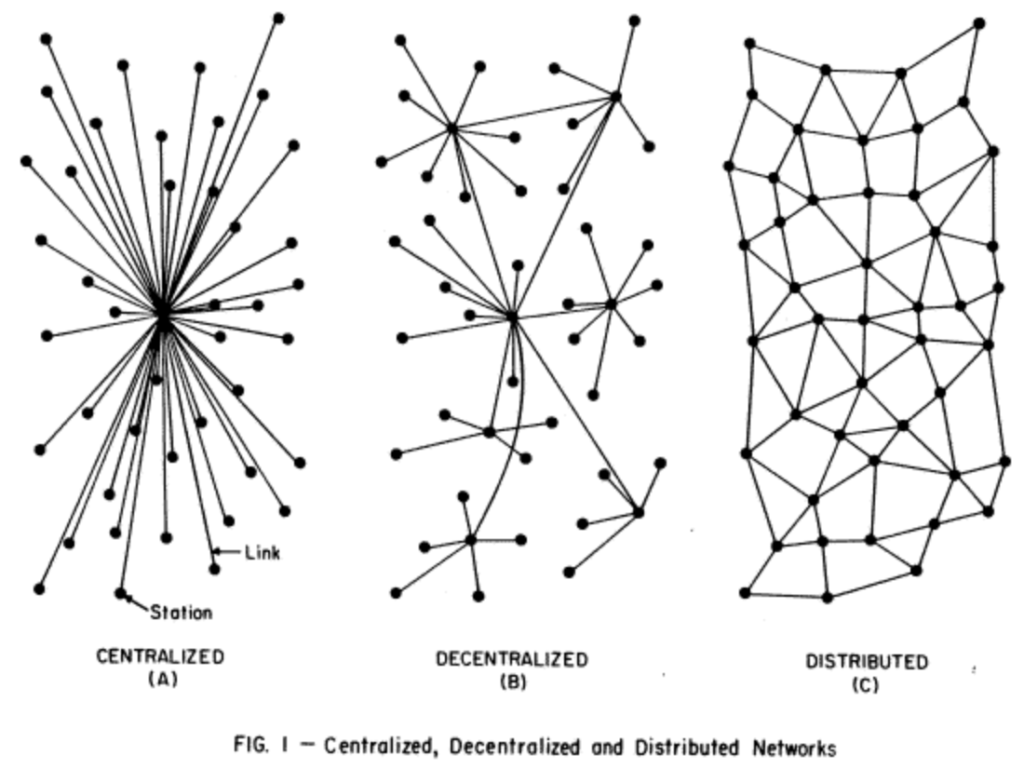
Baran’s diagrams showing highly decentralized topologies looked radical at the time. In a world of circuit switching, his concept of “hot-potato routing” and automatic resilience through redundancy seemed almost counterintuitive. It took several years for the idea to gain traction, and his reports circulated widely among researchers who would later build ARPANET.
Donald Davies and the language of packets
Across the Atlantic, at the National Physical Laboratory in the United Kingdom, Donald Davies arrived at a very similar idea. However, Davies approached the problem from a different angle. He focused on improving data flow efficiency rather than building a war-resistant network.
Davies believed that data transmission could be made far more effective if computers sent information in short, fixed-size units. He introduced the term “packet”, which soon replaced Baran’s “message blocks”. Davies also developed the first working packet switching testbed and demonstrated the idea in action.
His team’s NPL network was one of the earliest operational packet-switched systems. It showed that this new method was not only theoretical but practical. Davies’s work directly influenced researchers in the United States, including those designing ARPANET. When ARPA engineers visited the NPL network, they incorporated many of Davies’s ideas into the networking protocols that followed.
Why was packet switching revolutionary?
Before packet switching, communication systems largely used circuit switching. This meant that a dedicated path had to be set for the entire duration of a connection, as in early telephone systems. That approach was wasteful for computer data, which tends to be “bursty”, with short spikes of activity followed by silence.
Packet switching changed everything because it:
- Allowed networks to be shared by many users at the same time
- Delivered far higher efficiency and scalability
- Enabled routing around failures without human intervention
- Set the stage for internetworking, the blending of many separate networks into one universal system
These advantages became even more important as computers multiplied and diversified. Packet switching became the foundation that let networks grow without collapsing under complexity.
A combined legacy
Baran and Davies came to the same insight independently, each driven by the problems of their respective environments. Their work converged in the hands of the ARPANET engineers who built the first large-scale packet-switched network. From there, the idea spread across universities, military systems, and eventually the commercial internet.
The modern Internet’s ability to survive outages, manage billions of devices, and move data efficiently is a direct outcome of their conceptual leap.
Although neither Baran nor Davies became household names, their thinking is embedded in every connection we make. Packet switching is not simply a technical mechanism; it is the architectural philosophy that allowed the world to become networked.