











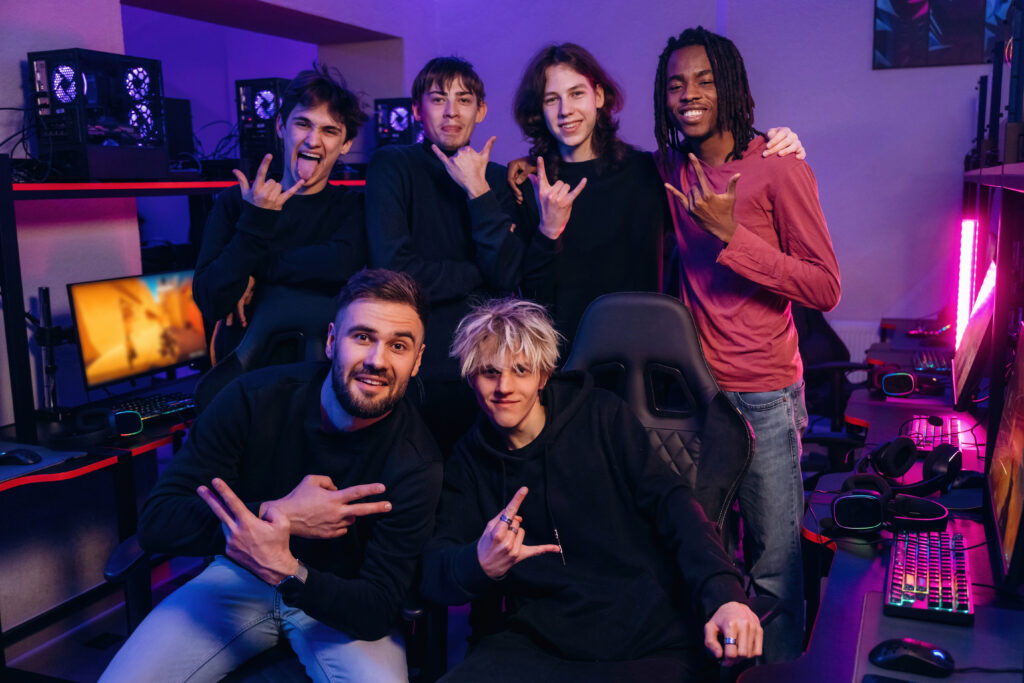
Discord is home to communities ranging from gaming clans and open-source developers to educators, political groups, creators, and global fandoms. What began as a niche tool for gamers has evolved into a global communication ecosystem used by hundreds of millions of people.
Yet the platform’s origins are surprisingly pragmatic. Discord was not initially designed to be a social network. Instead, it emerged from a technical problem encountered by two game developers attempting to build better multiplayer experiences.
The platform was created by Jason Citron and Stanislav Vishnevskiy, who launched the service publicly in 2015 through their company Discord Inc..
Their goal was straightforward: design a communication platform that worked seamlessly for real-time online collaboration, particularly for gaming communities that needed fast, reliable voice communication.
The communication problem in online gaming
Before Discord, gamers relied on a fragmented set of communication tools. Voice coordination during multiplayer games often required third-party software such as Skype, TeamSpeak, Ventrilo, or Mumble.
While these services allowed voice chat, they were not optimized for large or persistent communities.
Many required users to manually configure servers or maintain hosting infrastructure. Latency could be high, mobile support was limited, and moderation tools were rudimentary. Communities that wanted both text and voice communication often had to combine several platforms simultaneously.
Citron and Vishnevskiy believed the future of online communities required something different: a persistent communication hub that combined real-time voice, text channels, and community management tools in a single platform.
The beginnings
Jason Citron
Before founding Discord, Jason Citron had already built a successful startup within the gaming ecosystem.
He founded OpenFeint, a mobile social gaming network that allowed developers to add achievements, leaderboards, and social features to mobile games. The platform gained widespread adoption and was eventually acquired in 2011 by the Japanese gaming company GREE for approximately $104 million.
Following the acquisition, Citron founded a new game development studio called Hammer & Chisel. This studio was intended to focus on building multiplayer games, particularly those designed for emerging mobile platforms.
Stanislav Vishnevskiy
Stanislav Vishnevskiy, Discord’s co-founder and Chief Technology Officer, brought deep technical expertise to the company.
From a young age he had been interested in online communities and software development. As a teenager he built tools for gaming forums and community websites. Over time he developed strong expertise in backend infrastructure and distributed systems.
At Discord he became responsible for designing much of the platform’s technical architecture, including the infrastructure required to support real-time messaging and voice communication at massive scale.
The failed game that led to Discord
Ironically, Discord itself was born from a game that never succeeded. Hammer & Chisel’s main project was a multiplayer online battle arena game titled Fates Forever. The game was released for tablets and was intended to compete with titles in the MOBA genre.
While developing the game, the team encountered a recurring problem: communicating during development and testing was difficult. Existing voice chat tools performed poorly and required complicated setups.
To solve this issue internally, the team built their own voice communication system. What they discovered surprised them. The internal chat and voice system they had created worked better than existing tools. It was faster, simpler, and more reliable. Meanwhile, the game itself struggled to attract players.
Recognizing the opportunity, the founders made a dramatic decision: pivot the company away from game development and focus entirely on the communication platform they had created.
The architectural philosophy behind Discord
From the beginning, Discord was built around three core architectural principles.
Low-latency video communication
One of the most critical requirements for gaming communities is low-latency communication. Players coordinating strategies during fast-paced matches cannot tolerate delays or unstable connections.
Discord solved this by designing its infrastructure around globally distributed servers and optimized voice routing. By minimizing packet loss and improving audio stability, the platform provided a voice experience that felt nearly instantaneous.
This engineering focus became one of Discord’s defining strengths.
Persistent community servers
Another major innovation was the concept of persistent community spaces called servers.
Rather than creating temporary voice calls or ad-hoc chat rooms, Discord allowed communities to build permanent digital environments with structured channels. These servers could include multiple text channels, voice channels, and role-based permissions.
The model blended several earlier internet concepts:
- The community organization of online forums
- The real-time messaging of IRC networks
- The voice channels of gaming servers
By combining these elements into a single interface, Discord effectively created a new form of digital community platform.
Cloud-native infrastructure
Unlike older communication tools that required users to host their own servers, Discord relied on modern cloud infrastructure.
This approach allowed the company to automatically scale capacity as user numbers increased. New communities could be created instantly without needing technical expertise, and updates could be deployed centrally.
Cloud architecture also made it possible for Discord to support users across multiple devices, including desktop, mobile, and web browsers.
A rapid growth
Discord launched publicly in May 2015. Adoption spread rapidly through gaming communities, particularly among players of competitive multiplayer games.
In 2026, the platform had approximately 25 million users. In 2024, Discord counted more than 200 million monthly active users. What began as a gaming tool soon expanded into a general community platform.
Today Discord hosts a wide variety of communities including software developers, educators, cryptocurrency groups, artists, content creators, and global fan communities.
Venture capital and strategic investors
Discord’s rapid growth was supported by significant venture capital investment. The company raised funding from major technology investors including Index Ventures, Greylock Partners, and Benchmark.
These investors helped the company scale infrastructure, hire engineering talent, and expand globally.
The $10 Billion acquisition attempt
In 2021, technology giant Microsoft reportedly attempted to acquire Discord for approximately $10 billion. The offer was widely reported in the technology press and reflected Discord’s growing strategic importance in the digital communications ecosystem.
Discord ultimately declined the acquisition and chose to remain independent, signaling a long-term ambition to grow into a major platform rather than become part of another company’s ecosystem.
Discord's place among social media platforms
Today Discord occupies an unusual position among major online platforms. Unlike algorithm-driven social networks such as those operated by Meta Platforms, or short-video platforms created by ByteDance, Discord does not rely on content recommendation feeds.
Instead, the platform focuses on community-driven interaction. Users typically join servers through invitations and participate in smaller groups centered around shared interests. Communication happens within these structured communities rather than through public broadcast feeds.
This design has led some analysts to describe Discord not simply as a messaging app but as a “community operating system” for the internet.
From a gaming tool to global community infrastructure
The success of Discord highlights an important pattern in technology innovation: some of the most influential platforms begin as practical tools created to solve a specific engineering problem.
In Discord’s case, two game developers attempting to coordinate online gameplay built a system that ultimately transformed how millions of people organize digital communities.
What started as a voice chat tool for gamers has evolved into one of the most significant communication platforms of the 21st century—bridging social networking, messaging, collaboration, and online community management in a single ecosystem.