












In late 2022, two young Brazilian women (Desirrê Freitas and Letícia Maia) went missing in the United States. Their disappearance prompted a joint FBI and family-led search that surprisingly linked them to an Instagram wellness influencer with millions of followers. This is the story of Kat Torres, a “human Barbie” from Brazil, who went from partying with celebrities to prison with human trafficking charges.
Who is Kat Torres?
Katiuscia Torres Soares, better known as Kat Torres, is a Brazilian-born former model and Instagram “wellness influencer.”
Born in Belém, Pará, in 1988, she gained millions of followers by promoting spirituality, self-help, and a luxurious lifestyle. She also claimed psychic and healing abilities, published a self-help book, A Voz (“The Voice”), and offered paid one-on-one consultations.
The accusations
After the disappearance of Freitas and Maia, multiple women testified that Torres lured them with promises of success and spiritual guidance, then subjected them to psychological manipulation, forced labour, and exploitation. This included prostitution under threats, physical control over movement, and financial quotas.
Victims described living in deplorable conditions: working unpaid as personal assistants, sleeping on couches covered in cat urine, being isolated from one another, deprived of freedom, and forced to meet unrealistic earning demands.
In some cases, Torres allegedly employed “witchcraft” or spiritual intimidation to control her victims.
How did she do it?
Based on court testimony, police reports, and investigative journalism, Kat Torres used a mix of social engineering, cult-like control, and manipulation of vulnerabilities to convince people—mostly young women—to work for her:
- Recruitment through her Instagram persona
- Luxury lifestyle display: she showed photos of exotic travel, designer clothes, and celebrity connections (including photos with Leonardo DiCaprio) to create credibility and aspirational appeal.
- Wellness and spirituality branding: she presented herself as a life coach, a psychic, and a spiritual healer who could help followers “unlock their potential” or achieve fame and independence.
- Targeting vulnerable women: she contacted followers who had expressed personal struggles or ambitions online.
- Love-Bombing and personal promises
- She flattered her recruits and told them they were special or chosen for her inner circle.
- She promised career help in modeling, acting, or business, often implying access to wealthy or famous contacts.
- She offered free accommodation and “mentorship” at first to reduce initial skepticism.
- Isolation from support networks
- She moved victims away from their families and friends, sometimes to another country (e.g., U.S. from Brazil).
- In some cases, she confiscated their passports or documents.
- She limited the communication between the women under her control.
- Psychological and spiritual coercion
- She claimed she could predict the future or had mystical insight into their lives.
- She used “witchcraft” or spiritual threats—e.g., warning that bad things would happen if they left or disobeyed her.
- She told recruits they were part of a “mission” or “divine purpose” to justify exploitation.
- Control over living conditions
- She housed victims in cramped, unhygienic spaces.
- She restricted their freedom of movement: her victims needed permission to leave.
- She kept them in a constant state of dependence for food, housing, and work.
- Financial quotas and debt bondage
- She told her victims they owed her for housing, “training,” or travel costs.
- She required them to earn daily or weekly income through prostitution, escorting, or other labor.
- She threatened punishment or abandonment if they didn’t meet targets.
Kat Torres did this for personal financial gain: she kept the direct earnings from prostitution quotas, and she took advantage of unpaid domestic labour (such as cooking, cleaning, and administrative work). Her victims also acted as sales agents, facilitating paid “consultations” and online spiritual services.
Ultimately, photos and videos with an entourage of young women and her “followers” reinforced her brand as a successful spiritual guru and influencer.
The fall of an Instagram guru
In November 2022, police in Maine persuaded Torres and the two missing women to go to a sheriff’s office with a pretext, triggering the women’s rescue. Torres was arrested and deported to Brazil.
On June 28, 2024, a Brazilian court convicted her of human trafficking and slavery, sentencing her to eight years in a closed-regime prison.
The BBC produced a documentary, “Like, Follow, Trafficked: Insta’s Fake Guru,” exposing her methods and including her own interview from prison. Kat Torres continues to deny all charges and has appealed her conviction.
Breaking the manipulation cycle
Kat Torres’s strategy falls into the playbook of the manipulation cycle, as taught in law enforcement and human resources:
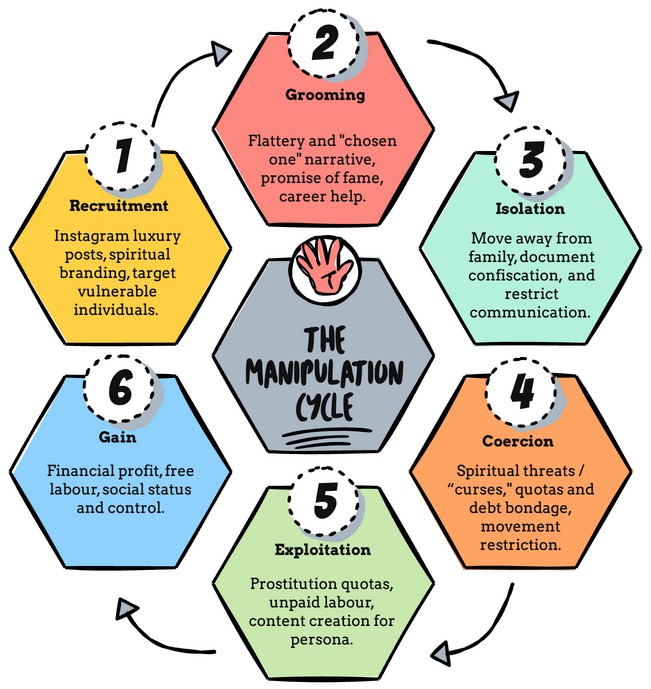
Breaking a manipulation cycle is extremely difficult because traffickers deliberately remove a victim’s freedom, support network, and sense of self. It usually takes outside intervention combined with small moments where the victim can act.
The first step, however, is for the victim to recognize the red flags: when the burden of the situation starts to outweigh the promises (e.g., broken commitments, physical abuse, impossible quotas). The victim must realize that the lifestyle or “mission” is harming them rather than helping.
This realization is sometimes triggered by witnessing another victim being mistreated or escaping.
An opportunity to be physically separated from the trafficker (such as a police stop, a hospital visit, or going to a store alone) is also a pretext to break the physical connection with the abuser and offer an escape.
- Victims rarely escape without help: traffickers control too many aspects of life.
- Take advantage of small cracks in the control: a trusted conversation, moment alone, or exposure to outside information can be enough to start the exit process.
- Support after leaving a trafficking experience is critical; without it, victims may return due to fear, financial instability, or emotional dependency.