











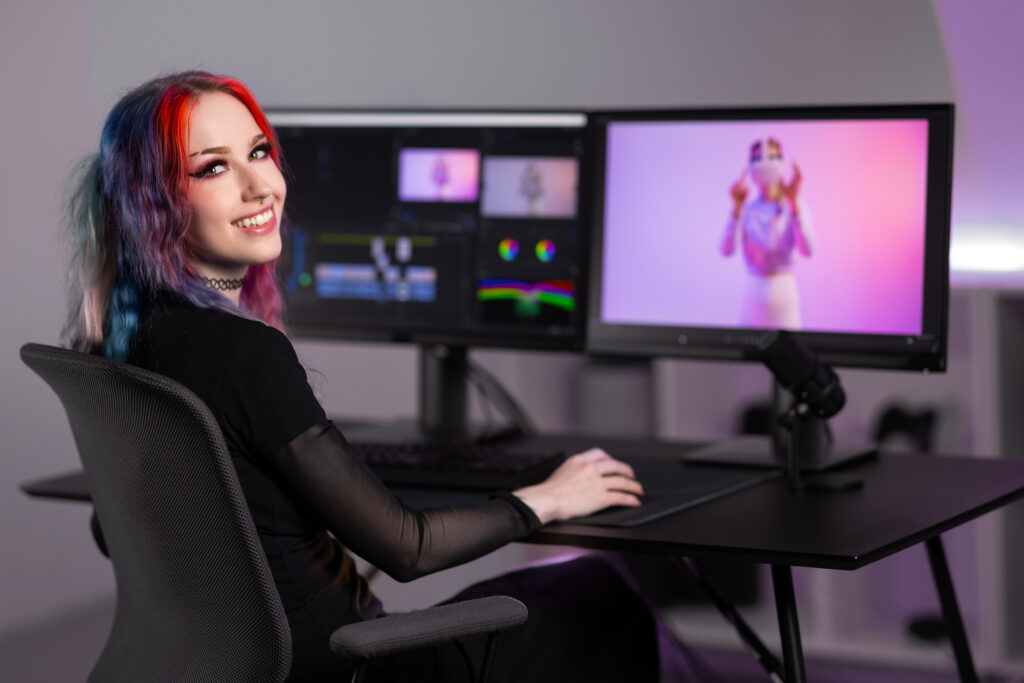
VTubers, short for Virtual YouTubers, are online content creators who appear as animated avatars rather than physical humans. Using motion capture, facial tracking, and voice acting, VTubers stream games, chat with audiences, sing, roleplay, and build communities while remaining physically anonymous.
What began as a niche Japanese experiment has evolved into a global entertainment ecosystem, blending anime aesthetics, livestream culture, idol economics, and parasocial fandom at scale.
From Kizuna AI to a global industry
The VTuber phenomenon began in Japan around 2016, with Kizuna AI, a virtual character presented as an autonomous AI personality. While the AI framing was quickly dropped, the concept of a persistent animated persona proved compelling.
Key accelerants of this concept were affordable facial tracking and Live2D rigging, in conjunction with YouTube and Twitch monetization tools. Animated avatars particularly appealed to anime and gaming crossover audiences, picking up in popularity during the COVID-period of exceptional livestream consumption.
By the early 2020s, VTubing had expanded well beyond Japan, with English-speaking, Spanish-speaking, and indie creators forming their own scenes.
How Vtubing works
Vtubing relies on a stack of tools that could be summarized (in a simplified setup) as follows:
The avatar acts as a buffer: it protects the Vtuber’s real-world identity, allows for exaggerated expression, enables roleplaying without full deception, and reduces appearance-based judgment. The performer is present, but mediated.
Corporate vs indie Vtubers
Agencies like Hololive, Nijisanji, and VShojo offer structured auditions and contracts for creators. They offer professionally-designed characters with an existing fan base, a high-tech tool stack, brand guidelines, merchandising, and set strict behavioural expectations. VTubers in agencies function similarly to digital idols, with tightly managed personas.
Independent Vtubers, instead, follow self-funded models and offer more creative freedom. They operate in smaller but often more intimate communities, taking on a higher personal risk and workload. Indies often experiment more with identity, humour, and the format of their videos.
The amplification of parasociality
VTubers intensify parasocial relationships through persistent fictional personas. They daily livestream routines, they interact directly with fans via chat, and they offer emotional story arcs and lore.
Fans often describe VTubers as comfort figures, background companions, and emotional anchors during isolation periods. The avatar paradoxically increases intimacy by reducing perceived social risk.
Language, rituals, and fandoms
VTuber communities develop strong in-group cultures with the use of custom emotes and slang, fan names and colour codes, call-and-response rituals in chat, and a clip culture to amplify key moments.
Examples include:
- Catchphrases repeated across streams
- Collective grief or celebration around milestones
- Shared taboos, such as avoiding the creator's real identity.
Identity, gender, and performance
VTubing destabilizes traditional identity markers. For example, the voice does not always match the avatar’s gender, the age and ethnicity of the creator are obscured, and disability and neurodivergence can be invisible or selectively disclosed.
This creates space for gender exploration, performative femininity or masculinity, and identity play without full disclosure. At the same time, it raises ethical questions about authenticity and expectation.
Risks and controversies
Vtubing has been criticized for carrying risks both creators and their fans:
For creators:
- Harassment and stalking
- Doxxing attempts
- Burnout due to constant performance
- Pressure to maintain character consistency
For fans:
- Emotional overinvestment
- Financial exploitation via superchats or donations
- Blurred boundaries between fiction and reality
The avatar can protect, but it can also trap.
Where are Vtubers?
While YouTube is the primary setting and archive for Vtubers’ videos, other platforms are involved with their activities: Twitch hosts Western indie VTubers, Twitter (X) is the place where creators engage their audiences. Core communities often engage on Discord servers, but on Reddit, you can find meta discussion and critique. Discord servers often function as parasocial reinforcement hubs, where norms and loyalty are socially enforced.
The future of digital labour
VTubers represent a shift toward identity as intellectual property, performers as replaceable or franchised, labour hidden behind fictional branding, and the exploitation of emotional labour at industrial scale. They foreshadow broader trends in virtual influencers, AI personas, and synthetic media.
A prototype for identity monetization
VTubers are not a novelty. They are a prototype. They show how identity can be abstracted and monetized, and how parasocial intimacy can scale safely, until it doesn’t. In the Vtuber world, anonymity can coexist with fame, and community can form around a fiction that feels real.
VTubers blur the line between authenticity and artifice, presence and performance. The emotions involved are real, even if the face is not.