











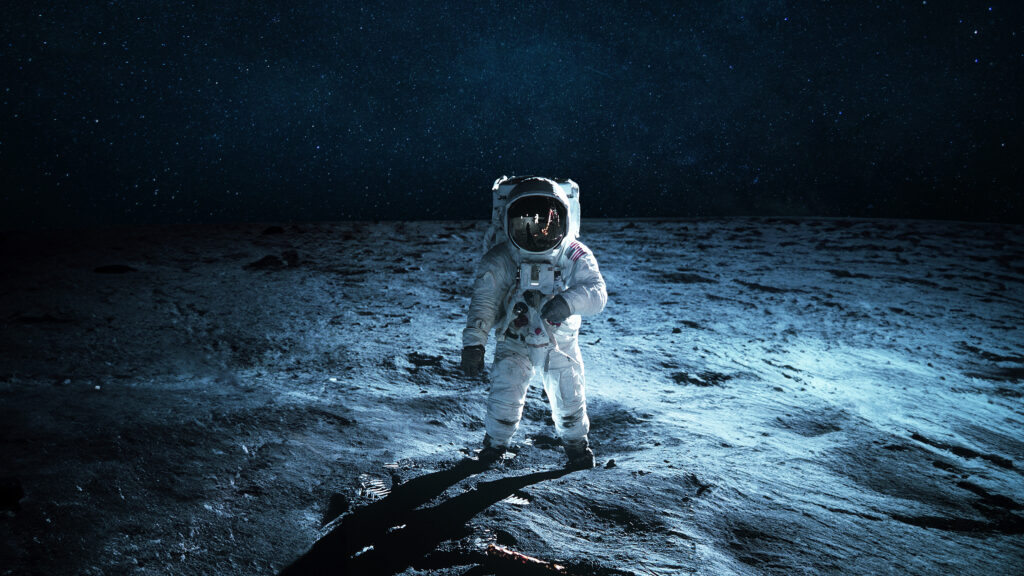
Few conspiracy theories have achieved the cultural longevity of the claim that the Apollo Moon landings were staged. Despite extensive documentation, physical evidence, and decades of scientific verification, the idea that humans never landed on the Moon continues to circulate in popular culture and online communities.
At its core, the Moon landing hoax narrative argues that the United States fabricated the 1969 mission in order to win the Cold War space race against the Soviet Union. The theory suggests that the historic landing of Neil Armstrong and Buzz Aldrin during Apollo 11 Moon Landing was filmed on Earth rather than carried out on the lunar surface.
The persistence of the theory reveals more about how distrust spreads than about what happened in 1969.
The origin of the Hoax narrative
Doubts about the Moon landing began appearing almost immediately after the event. However, the conspiracy gained widespread attention in 1976 with the publication of We Never Went to the Moon by Bill Kaysing, a former technical writer for a contractor involved in the Apollo program.
Kaysing argued that the technological challenges of reaching the Moon were insurmountable and that the mission was staged to demonstrate American superiority during the Cold War. His book laid out many of the arguments that still circulate today, including claims about photographic anomalies and supposed inconsistencies in the footage.
The book’s success coincided with a period of declining trust in government following the Watergate Scandal and the Vietnam War, making audiences more receptive to claims of large-scale deception.
Common misinterpretations
Moon landing hoax theories typically focus on a small set of recurring observations.
The “waving” flag
Critics argue that the American flag appears to wave in the footage despite the absence of atmosphere on the Moon. In reality, the flag was mounted on a horizontal rod to keep it extended, and the apparent motion is caused by astronauts twisting the pole while planting it.
No stars in the photographs
Suspicious shadows
Skeptics claim that inconsistent shadows suggest multiple light sources, as would be expected in a film studio. In reality, uneven lunar terrain and wide-angle lenses create optical distortions that affect the perceived direction of shadows.
These claims illustrate how unfamiliar environments can create visual anomalies that appear suspicious when interpreted without context.
The scale problem
One of the most significant challenges to the hoax theory is logistical. The Apollo program involved approximately 400,000 engineers, technicians, and scientists, as well as numerous contractors and institutions.
Maintaining a staged landing would have required coordinated secrecy across thousands of individuals and multiple government agencies for more than half a century.
Moreover, the Soviet Union, which had every incentive to expose American deception during the Cold War, never challenged the legitimacy of the missions.
Physical evidence
Several lines of independent evidence confirm the reality of the Moon landings.
Astronauts from Apollo missions brought back 382 kilograms of lunar rock samples, which have been studied by laboratories worldwide and possess isotopic compositions distinct from terrestrial materials.
Retroreflectors left on the Moon by Apollo astronauts are still used today by scientists who bounce lasers from Earth to measure the distance between the Earth and the Moon with extreme precision.
Orbital imagery from later spacecraft also shows landing sites, equipment, and rover tracks left on the lunar surface.
Cultural persistence
Despite overwhelming evidence, the Moon landing hoax remains popular in certain circles. The theory has been reinforced by documentaries, internet forums, and social media videos that reinterpret archival footage through a conspiratorial lens.
Some versions of the theory even claim that filmmaker Stanley Kubrick secretly directed staged footage of the Moon landing, an allegation that has become part of broader cultural mythology.
The narrative persists not because evidence supports it, but because it aligns with broader patterns of institutional distrust.
Why the theory endures
Several factors explain the endurance of the Moon landing hoax narrative.
First, the scale of the achievement feels implausible to many observers. Landing humans on another celestial body within a decade of the first spaceflight appears almost unbelievable.
Second, modern audiences encounter the event primarily through images and recordings rather than direct experience. This distance allows reinterpretation and doubt to flourish.
Finally, conspiracy thinking often thrives in environments where technological expertise feels inaccessible. When people cannot easily verify technical claims, alternative explanations become attractive.
Advancements as illusions
The Moon landing hoax theory illustrates how extraordinary achievements can become targets of extraordinary suspicion. Rather than celebrating technological milestones, conspiracy narratives reinterpret them as elaborate illusions.
Understanding how such narratives spread requires careful analysis of information sources, digital amplification, and the psychology of distrust.
For organizations facing reputational or informational risks in similar environments, Negative PID conducts open-source intelligence investigations and digital risk assessments to separate fact from speculation: https://negativepid.com/