











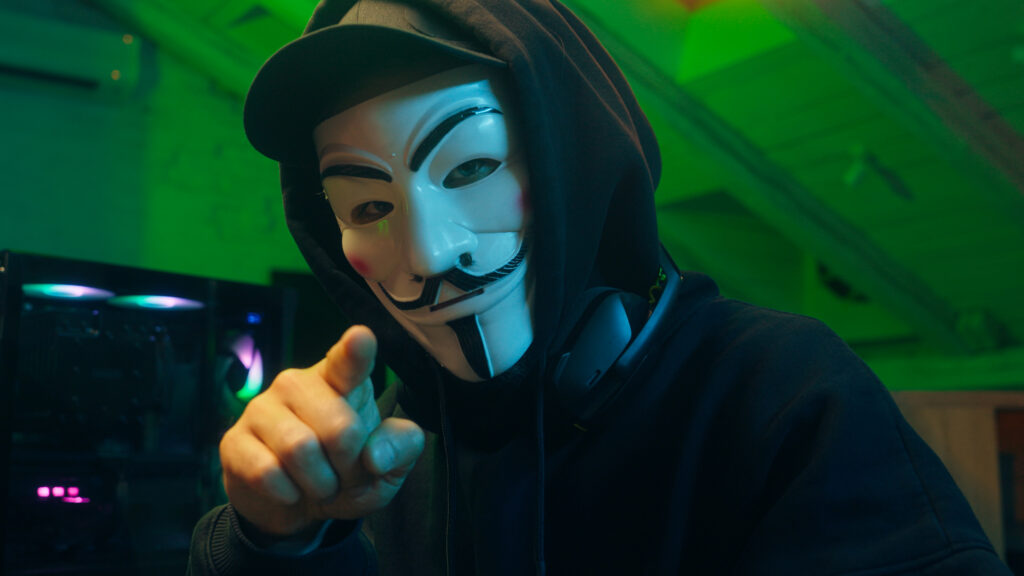
When Anonymous first appeared on the global stage, the world didn’t quite know what to make of it. Were they digital freedom fighters? Cybercriminals? Vigilantes? Terrorists? The answer was — and remains — all of the above, depending on who you ask. In the ungoverned space between law and ethics, Anonymous forged a new kind of power: digital civil disobedience with no leaders, no accountability, and no boundaries.
The grey zone of digital protest
In the physical world, protest has rules. Demonstrators occupy streets, not servers. Civil disobedience implies peaceful resistance — disruption, yes, but without destruction. Online, those lines blur.
When Anonymous launched DDoS attacks against PayPal and Visa in 2010 to defend WikiLeaks, members compared their actions to a virtual sit-in — blocking traffic to make a statement. But prosecutors disagreed.
Under U.S. law, a DDoS attack constitutes unauthorized impairment of a computer system, not protected speech. Several participants in Operation Payback were sentenced to prison.
The ethical debate split even supporters. If a million people can peacefully occupy a square, why can’t a million packets occupy a website?
“The law hasn’t caught up with what protest looks like online,” one Anonymous sympathizer told The Guardian. “If they shut down our voices, we’ll shut down their servers.”
The ideology of the greater good
Anonymous justified many of its attacks as serving a moral or political purpose — exposing corruption, fighting censorship, avenging injustice. But that justification was flexible.
During Operation DarkNet, members took down child exploitation sites, earning praise even from critics. But during Operation Sony, thousands of user credentials were leaked, exposing innocent people’s private data in the process. Hacktivism, it turned out, could cause collateral damage — and Anonymous was often too decentralized to care.
Inside the IRC channels, participants debated ethics endlessly. Some argued that leaking personal data was a necessary evil — “exposure as justice.” Others condemned it as the very abuse of power they claimed to oppose.
The paradox of Anonymous was always the same: a movement fighting for transparency while hiding behind total secrecy.
Vigilantes without borders
In the post-9/11 world, Anonymous became part of the broader debate on digital vigilantism. From #OpISIS to #OpRussia, the group intervened in geopolitical conflicts with little coordination and zero oversight.
Governments, intelligence agencies, and cybersecurity experts all voiced the same concern: when an unaccountable online collective engages in cyberwarfare — even for a “good cause” — it risks escalation and misinformation.
In 2015, after Anonymous declared war on ISIS, researchers warned that the group’s efforts could disrupt official counterterrorism investigations and even expose civilian informants. But from the Anonymous perspective, inaction was complicity.
“We don’t wait for permission to act. When governments move too slowly, we move first.”
Anonymous
This was hacktivism as moral intervention — a self-appointed digital justice system unconstrained by borders or laws.
“We Are Not Criminals. We Are the Alarm System.”
“Sometimes laws lag behind ethics. If breaking a firewall reveals a government’s hidden abuses, who is really committing the crime?”
Anonymous IRC user, 2011
The Anonymous ethos has always existed in a moral gray zone. Many early members argued that their hacks were acts of exposure, not destruction — pointing out hypocrisy, censorship, and corporate abuse.
Hacktivist logic often ran like this:
- Governments protect data, not truth.
- Whistleblowers get silenced.
- So digital intervention becomes a moral necessity.
The law's perspective: no heroes
To law enforcement, the distinction between hacktivist and hacker is irrelevant.
The FBI, Interpol, and Europol have consistently categorized Anonymous operations as cyberattacks — crimes under the Computer Fraud and Abuse Act (CFAA) and its international equivalents.
When the FBI arrested members of LulzSec and other Anonymous factions in 2011, officials called the group “a loose confederation of computer hackers and criminals.” The courts agreed: intent didn’t matter; unauthorized access did.
This legal rigidity created an enduring tension: the law treats all breaches equally, but the public doesn’t. To many, exposing government secrets or supporting protesters in Tunisia didn’t carry the same moral weight as stealing credit cards or doxxing rivals.
Hacktivism: Civil Disobedience or Computer Crime?
The legal boundary between activism and cybercrime is blurry and jurisdiction-dependent. Under most laws — including the U.S. Computer Fraud and Abuse Act (CFAA) and the UK Computer Misuse Act — unauthorized access equals a criminal act, no matter the motive.
Yet, human rights frameworks like the Universal Declaration of Human Rights (Article 19) protect freedom of expression, even digital protest. This clash between motive and method is the crux of the Anonymous paradox.
Case studies:
- Operation Payback (2010): DDoS attacks against anti-WeakiLeaks corporations; dozens of arrests under CFAA.
- Operation Tunisia (2011): Helped protesters bypass censorship. Celebrated by activists, condemned by authorities.
- Operation Ferguson (2014): Support for racial justice protests; sparked debates about digital vigilantism.
Between chaos and conscience
What made Anonymous unique — and unstable — was its moral diversity. There was no central doctrine, no vetting process, no ethics board. Each operation depended on whoever showed up. Some Anons sought justice; others sought chaos; some simply wanted attention.
This fluidity made Anonymous powerful — a digital swarm that could strike anywhere — but also ideologically incoherent. One operation could be hailed as activism; the next, condemned as cybercrime.
In the words of Gabriella Coleman, an anthropologist who studied the group:
“Anonymous is a hydra — cut off one head, and another appears, but each head speaks a different language.”
Gabriella Coleman
The paradox of legitimacy
Perhaps the deepest dilemma for Anonymous is legitimacy. Traditional activism relies on visibility: leaders, organizations, manifestos. Anonymous thrives on invisibility — its very name rejects identity.
That anonymity allows dissent without fear, but also erases responsibility. Without accountability, who answers for the harm? When stolen data is leaked, when systems are crippled, when lives are affected — there is no chain of command, only digital ghosts.
The movement’s greatest strength — its lack of hierarchy — is also its ethical blind spot.
The legacy of hacktivism
Anonymous forced society to confront an uncomfortable truth:
digital protest can be as disruptive as physical protest, and sometimes as effective. It also forced cybersecurity professionals, governments, and citizens to rethink what justice looks like in a networked world.
The group’s chaotic campaigns inspired new generations of hacktivists — from GhostSec to Cyber Partisans — but also stricter cybercrime laws and more aggressive surveillance.
In the end, Anonymous didn’t resolve the ethical debate; it embodied it.
It showed that in cyberspace, power and morality don’t always align and that anonymity, once seen as a shield for the weak, can also hide the hand that strikes.
“We are not your enemy. We are your wake-up call.”
Anonymous