











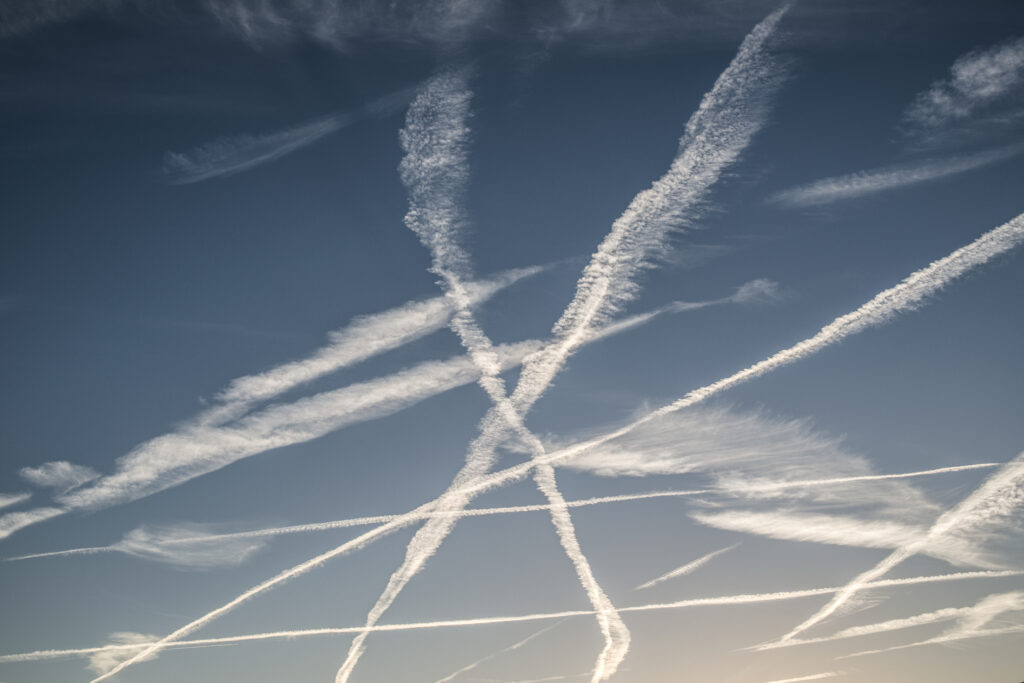
The chemtrail narrative sits at the intersection of environmental concern and institutional distrust. It proposes that the white trails left behind aircraft are not condensation, but deliberate chemical dispersals carried out for weather manipulation, population control, or covert experimentation.
While atmospheric science identifies these trails as contrails, short for condensation trails, the persistence of the chemtrail belief reflects something deeper than misunderstanding. It reflects anxiety about ecological instability, technological opacity, and power without visibility.
Where the chemtrail narrative comes from
Contrails have existed since high-altitude aviation became common during the Second World War. Under specific humidity and temperature conditions, aircraft exhaust condenses and freezes, forming visible ice-crystal trails.
The chemtrail narrative emerged in the 1990s, gaining traction through early internet forums. It drew from Cold War fears of secret experimentation, public knowledge of historical unethical testing programs, and growing environmental activism. The distrust of military and intelligence institutions consolidated these beliefs.
Once online communities formed around the idea, visual evidence became self-reinforcing. The sky itself appeared to confirm suspicion.
The difference between contrails and chemtrails
From a scientific standpoint, contrails are explained through basic atmospheric physics. Jet engines emit water vapour. At high altitudes, where temperatures can drop below −40°C, that vapour freezes into ice crystals.
Contrails may disperse quickly or persist and spread into cirrus-like clouds. They can also intersect and form grid patterns. The variability depends on atmospheric conditions, not on differing chemical compositions.
However, the persistence of certain trails, especially when they spread across the sky, is often interpreted as evidence of intentional spraying.
Geo engineering and the anxiety gap
Part of the chemtrail narrative’s durability comes from its overlap with real discussions about geoengineering. Climate scientists have openly debated theoretical methods such as stratospheric aerosol injection to reflect sunlight and reduce warming. These proposals are controversial, largely experimental, and not implemented at global scale.
Yet the mere existence of geoengineering discourse creates what might be called an anxiety gap. If scientists are discussing atmospheric intervention, some assume it must already be happening covertly. In an era of climate emergency, the line between mitigation research and imagined deployment becomes psychologically unstable.
Eco-Anxiety as a cultural driver
Eco-anxiety describes chronic fear about environmental collapse. It is increasingly documented among younger populations and communities experiencing climate-related disruption. Chemtrail narratives transform diffuse ecological fear into a concrete culprit.
Instead of complex systemic emissions, industrial history, global consumption patterns, and policy failures, the threat becomes intentional, centralized, and controllable.
The blame shifts from collective responsibility to secret orchestration. This reframing provides emotional clarity. Random crisis is harder to process than directed harm.
Visual culture and sky watching
The chemtrail belief is uniquely visual. Unlike abstract conspiracy claims, it invites daily observation. Participants photograph skies, track flight paths, and share time-lapse imagery.
Digital platforms amplify this activity through pattern recognition communities, algorithmic reinforcement, and the circulation of viral videos.
When images are framed with suspicion, normal atmospheric variations become interpreted as anomalies. Human cognition is predisposed to detect patterns, even when none exist. In uncertain times, pattern detection becomes heightened.
Historical precedents of atmospheric fears
Public fear of invisible airborne harm is not new. During the Cold War, nuclear fallout anxiety shaped generational consciousness. Earlier still, industrial pollution created visible smog crises that governments initially denied.
Historical episodes of secrecy and environmental damage have contributed to institutional distrust. The chemtrail narrative borrows credibility from real historical failures.
The difference lies in the evidence. While industrial pollution and nuclear fallout were measurable and documented, chemtrail claims lack empirical confirmation.
Why the narrative persists
The chemtrail narrative persists because it combines ecological vulnerability, technological complexity, institutional mistrust, and visual immediacy.
It also offers community. Shared sky observation becomes participatory activism. Believers feel vigilant rather than powerless. When the environment is unstable, agency matters psychologically.
Broader implications
Chemtrails are less about aircraft emissions and more about a crisis of trust in systems managing planetary risk.
Climate change is real. Geoengineering research exists. Aviation does contribute to atmospheric change. However, conflating scientific uncertainty with secret chemical warfare shrinks complex causes into a mere and vague accusation.
The deeper challenge is rebuilding transparent communication between scientific institutions and the public. When transparency weakens, speculation fills the gap.
For those seeking clarity on environmental claims, Negative PID provides OSINT-based digital investigations and risk assessments for the protection of the environment. Learn more at https://negativepid.com/services/for-the-environment/.