











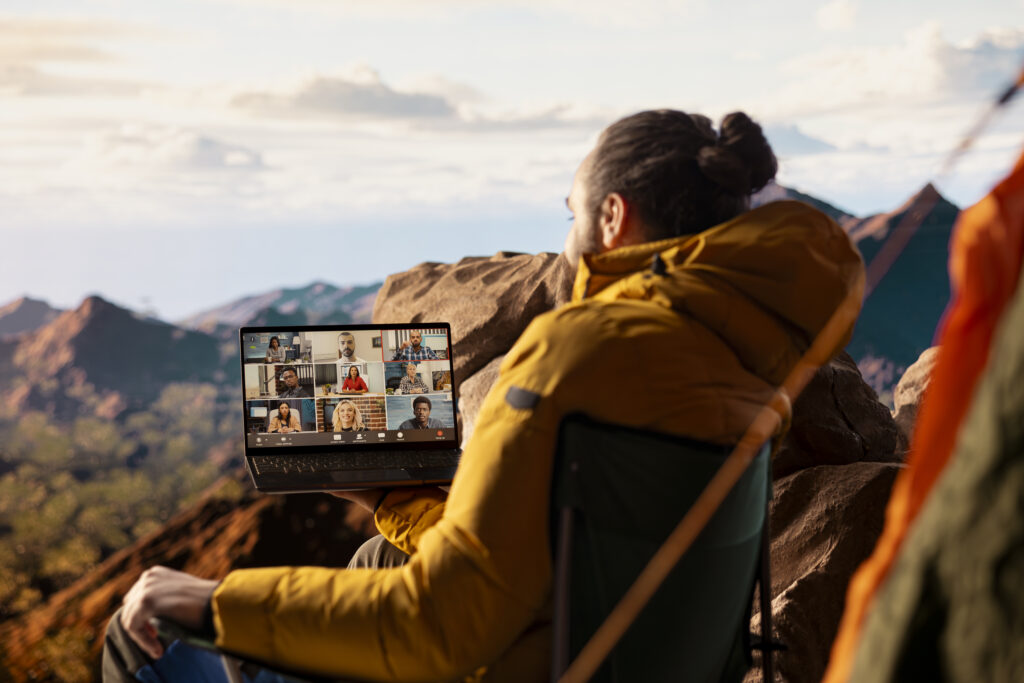
Digital nomads are individuals who earn income online while living transiently across countries or cities. Enabled by remote work, cloud platforms, and global payment systems, the digital nomad has become a recognizable figure in online culture, often portrayed as a laptop-on-the-beach ideal.
Behind the imagery lies a more complex reality shaped by platform dependency, legal grey zones, and unequal access to mobility.
From freelancers to cultural identity
Early digital nomads emerged in the late 2000s and early 2010s, primarily from freelance tech workers, online marketers and SEO specialists, remote consultants and developers, and early crypto and startup communities.
Blogs, forums, and later social media transformed nomadism from a working arrangement into a performative identity.
Platforms that enable nomadism
Digital nomads rely heavily on platform infrastructure such as:
Loss of platform access can mean immediate income loss.
The legal and Visa grey zone
Most digital nomads operate in ambiguous legal territory when it comes to tourist visas used for work in countries where there are no digital nomad visas, inconsistent tax residency status, limited labour protections, and fragmented healthcare coverage.
Recently, some countries have adopted digital nomad visas to capture foreign income. On the other hand, there is also increased scrutiny of overstays and undeclared work. Legal clarity remains uneven and selective.
Nomad hubs and digital enclaves
Certain cities have become digital nomad hubs due to their favourable conditions for nomadic work. Amongst them are Lisbon, Bali, Chiang Mai, Medellín, and Tbilisi.
These hubs often form parallel economies with co-working spaces, English-speaking service layers, and nomad-only social circuits. This can create tension with local communities due to rising costs and cultural segmentation.
The performance of freedom
Inequality and selected mobility
Community and loneliness
While nomads often describe strong communities, these are temporary, transactional, and platform-mediated.
Arther than joining a secret, exclusive club, common patterns include rapid bonding followed by disappearance. Digital nomad communities online have a high social churn, and they often bring emotional fatigue from constant reintroduction.
Discord servers and WhatsApp groups function as semi-stable social anchors.
Surveillance, security, and risks
The appeal of a nomadic life
Digital nomads’ lifestyle is attractive because it seems to merge the best of all worlds: living freely while travelling and discovering the world with the security of a salary.
Digital nomads are a demonstration that labour can be decoupled from the workplace thanks to technology. They are a test case for how work, identity, and geography intersect online.
However, this freedom depends on third-party platforms, the uneven distribution of mobility, and the cultural shift from stability to flexibility as a norm.
Digital nomadism promises autonomy, but delivers it conditionally. Mobility is real, but bounded by law, infrastructure, and power.