







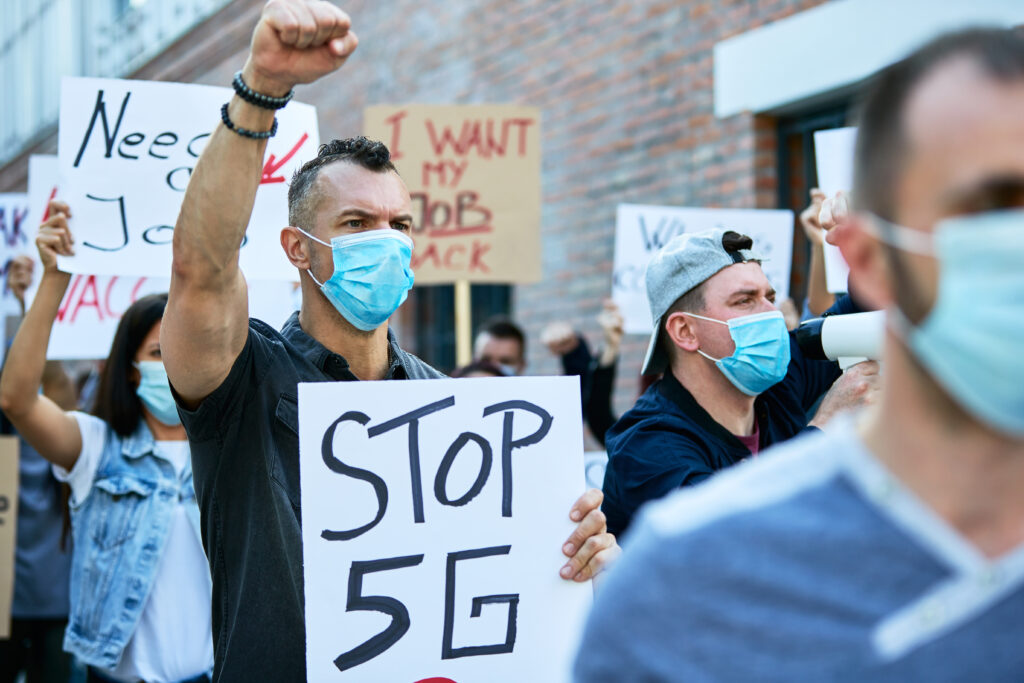
In early 2020, as the world was coming to terms with an unknown and fast-spreading virus, another kind of contagion began spreading: digital and psychological at once. A growing online narrative claimed that 5G technology was somehow responsible for the COVID-19 pandemic, either by “weakening immune systems,” “spreading the virus through radio waves,” or as part of a secret population-control plan.
Within months, this 5G–COVID conspiracy went from obscure forums to mainstream social media feeds, igniting vandalism, arson, and violence against telecom engineers worldwide. It was an example of how the fear of the unseen can be weaponized by misinformation.
The Origins: Fear Meets Complexity
The roots of the 5G panic predate COVID-19. When fifth-generation mobile networks (5G) were first announced around 2018, many people expressed unease over their higher-frequency radio waves and the dense network of antennas required. Online health-scare groups recycled decades-old electromagnetic-radiation myths, linking them to cancer, infertility, and “mind control.”
When the pandemic hit, these narratives merged seamlessly with pandemic-era paranoia. Influencers on Facebook, YouTube, and Telegram began claiming that:
- 5G towers “activated” the coronavirus.
- Lockdowns were cover operations to install more towers.
- Bill Gates and tech companies orchestrated a global hoax to control populations through wireless tracking or microchips.
What began as pseudoscience evolved into political distrust: a perfect storm of uncertainty, fear, and anti-establishment sentiment.
The viral mechanism
The 5G–COVID narrative spread globally in days:
- March 2020: A Belgian newspaper published an interview suggesting a link between 5G and the virus. The article was later retracted, but screenshots persisted.
- April 2020: Videos on YouTube and Facebook amassed millions of views claiming “proof” that Wuhan was “the first 5G city.”
- Telegram and WhatsApp chains multiplied the message with doctored maps aligning COVID-19 outbreaks with 5G coverage zones.
- Celebrity amplification: British musician Keri Hilson and actor Woody Harrelson repeated the claim on social media, giving it mainstream reach.
It was a classic case of information cascades, where visibility is mistaken for truth.
From online panic to real-world attacks
The consequences were immediate and measurable: in the United Kingdom, more than 100 cell towers were vandalized between March and May 2020. Telecom engineers were harassed or assaulted while performing maintenance work. Similar incidents occurred in the Netherlands, Ireland, Cyprus, and Canada.
The UK’s Ofcom and National Cyber Security Centre issued warnings, while Facebook and Twitter began removing posts under new “harmful misinformation” policies. Yet each removal seemed to feed the narrative of censorship, ultimately reinforcing the conspiratorial mindset that “they’re hiding something.”
Why people believed it
Psychologists studying digital rumor cycles identified several contributing factors:
- Pattern-seeking bias: People under stress link unrelated events to regain a sense of control.
- Technological illiteracy: Most users cannot distinguish between ionizing and non-ionizing radiation, making “5G as a virus vector” sound plausible.
- Authority mistrust: Decades of corporate scandals and government secrecy made denials sound suspect.
- Algorithmic amplification: Engagement-based ranking rewarded emotional content (anger, fear, outrage) accelerating the reach of each post.
This combination produced a self-reinforcing feedback loop: fear → clicks → more visibility → deeper belief.
The data perspective
Researchers from the Oxford Internet Institute and Reuters Institute tracked the spread of 5G–COVID posts across major platforms. Their findings showed that mentions of “5G + coronavirus” on Twitter peaked in April 2020, with over 200,000 tweets in a single month. Facebook and YouTube were responsible for over 90 % of early exposure before content moderation began. After deplatforming, the conversation migrated to Telegram and Gab, where activity persisted for another year.
These numbers reflect a new reality: once seeded, conspiracy content does not disappear. It decentralizes.
Countermeasures
In response, multiple actions were taken: YouTube banned all content linking 5G to COVID-19. Facebook deployed WHO-backed fact-checking banners under related posts. UK law enforcement treated tower attacks as domestic terrorism threats.
However, the counter-disinformation response was reactive, not preventive. By the time official debunkings circulated, the narrative had already globalized through encrypted channels beyond moderation’s reach.
Long-term consequences of misinformation
The 5G–COVID myth had lasting effects. It delayed infrastructure deployment in several European cities and eroded trust in science and health institutions during a critical public-health crisis. It also became a gateway ideology, as many 5G believers later embraced QAnon and anti-vaccine conspiracies.
This crossover shows how conspiracies operate as networks, not isolated beliefs. Once a person distrusts one authority, alternative narratives become easier to adopt.
Lessons learned
- Transparency beats silence. Early, clear communication about how technologies work can pre-empt speculation.
- Platform responsibility matters. Algorithms tuned for engagement amplify fear faster than fact.
- Digital literacy is national security. Understanding misinformation mechanics is as vital as understanding malware.
Today, 5G networks operate in nearly every major city, powering the next generation of communications. Yet the “5G kills” slogan still surfaces online.
The pandemic may have faded, but the psychological infrastructure of conspiracy (mistrust, fear, and digital echo chambers) remains intact.