











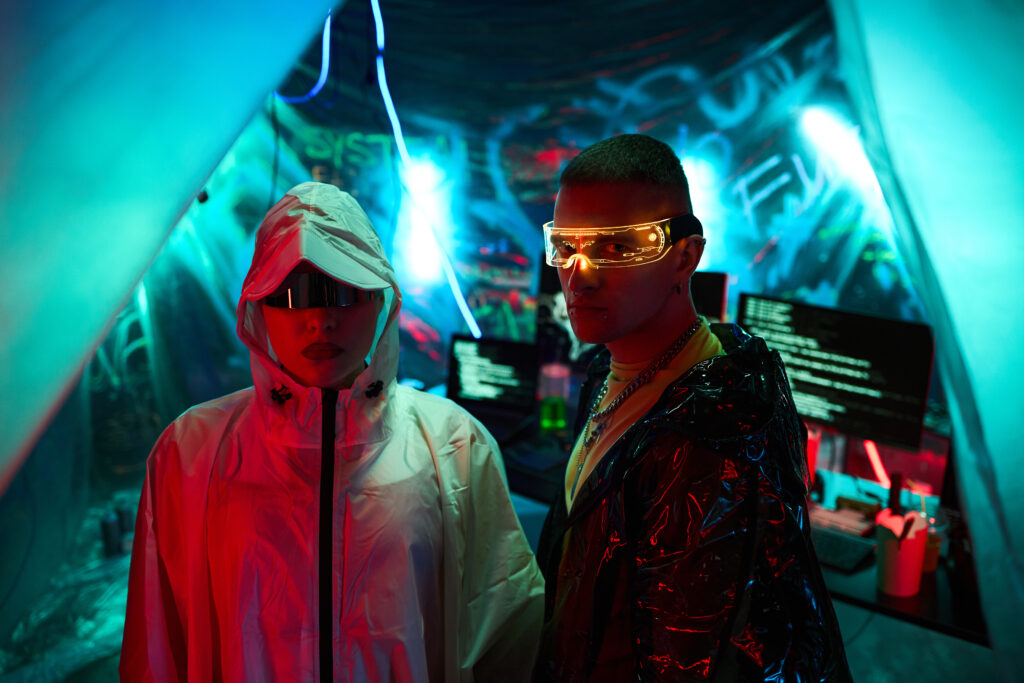
Neon-lit megacities, mass surveillance, powerful corporations, and individuals navigating the margins of digital society: that’s the essence of cyberpunk across literature, filmography, and gaming. Yet cyberpunk is more than a fictional genre. It has become a living culture online.
Cyberpunk communities gather around the aesthetic, philosophy, and technological themes associated with the genre. These groups blend fiction, technological curiosity, political critique, and digital experimentation. For many participants, cyberpunk is not simply entertainment. It is a framework for interpreting the present and imagining alternative futures.
In a world increasingly defined by data collection, artificial intelligence, and platform monopolies, cyberpunk’s predictions no longer feels speculative.
Literature, technology, and counterculture
Cyberpunk emerged during the late twentieth century, particularly in the 1980s, through a group of science fiction writers who sought to depict the social consequences of advanced technology.
Key themes included:
- Corporate dominance over public institutions
- Networked computer systems connecting global society
- Artificial intelligence and cybernetic augmentation
- Economic inequality within technologically advanced cities
- Hackers navigating digital infrastructure
The genre presented a contrast between technological progress and social fragmentation. The famous phrase often associated with cyberpunk captures this tension: “high tech, low life.”
Early cyberpunk narratives imagined a world where advanced computing power coexisted with deep social inequality. In many respects, the internet age brought those themes closer to reality.
From fiction to online subculture
As internet access expanded during the 1990s and 2000s, cyberpunk shifted from literary genre to cultural reference point. Forums, blogs, and online communities began discussing cyberpunk not only as fiction but as a lens through which to interpret technological change.
Participants in cyberpunk communities often share interests in emerging technologies, privacy and digital rights, cryptography and decentralized systems, cybersecurity and hacking culture, futuristic design and aesthetics.
In this sense, cyberpunk communities blend speculative imagination with practical technological awareness.
Neon, steel, and digital decay
Cyberpunk has developed one of the most recognizable aesthetic languages on the internet. Visual motifs frequently include neon lighting against dark urban landscapes, rain-soaked streets and towering skyscrapers, augmented bodies and cybernetic implants, dense cityscapes filled with advertisements and screens, and analog technology combined with futuristic systems.
These visuals circulate widely on platforms like Reddit, Pinterest, and Instagram, forming part of a broader ecosystem of digital aesthetics.
The aesthetic is not purely decorative. It communicates a worldview in which technological abundance exists alongside social fragmentation.
Cyberpunk as social critique
Beyond its visual identity, cyberpunk functions as a form of cultural critique. The genre’s themes resonate with contemporary concerns such as the power of large technology corporations, mass surveillance and data collection, algorithmic influence on social behaviour, wealth concentration within technology sectors, and the erosion of privacy in digital environments.
For many community members, cyberpunk is not simply dystopian fiction but a warning. They see aspects of the genre reflected in current technological developments.
This perspective gives cyberpunk communities a strong analytical dimension. Discussions often explore how technological systems reshape power and social organization.
Overlap with hacker culture
Cyberpunk communities frequently overlap with hacker and cybersecurity cultures. Both share an interest in understanding and manipulating technological systems.
Common points of intersection include:
In cyberpunk narratives, hackers often serve as protagonists navigating powerful systems from the margins. This figure resonates with many participants who view technological literacy as a form of empowerment.
Cyberpunk and the maker ethos
Another dimension of cyberpunk communities is the maker culture surrounding hardware modification and technological experimentation.
Participants may engage in activities such as building custom electronics, experimenting with wearable technology, modifying hardware devices, creating interactive art installations, and designing cyberpunk-inspired gadgets or interfaces.
These practices transform cyberpunk from speculative fiction into hands-on technological exploration.
Digital communities and platforms
Cyberpunk communities gather across several types of online spaces.
Reddit hosts large communities dedicated to cyberpunk imagery, discussion, and technological speculation. Discord servers provide smaller spaces for collaborative projects and conversation. Independent blogs and forums often focus on deeper technical or philosophical exploration.
Visual platforms like Pinterest and Instagram contribute to the spread of cyberpunk aesthetics, while longer discussions about technology and society appear in more text-oriented environments.
These platforms collectively sustain the cultural ecosystem surrounding cyberpunk.
Nostalgia and retro futurism
A curious feature of cyberpunk communities is their relationship with nostalgia. Many cyberpunk aesthetics draw inspiration from technological visions of the late twentieth century.
Elements such as CRT monitors, early computer interfaces, analog synthesizers, retro digital displays, appear frequently in cyberpunk imagery.
This blend of past and future produces a form of retro-futurism, where earlier visions of technological advancement are revisited and reinterpreted.
In doing so, cyberpunk communities preserve alternative technological imaginations that diverge from the sleek minimalism of contemporary consumer technology.
Cyberpunk in the age of real tech
One reason cyberpunk communities remain vibrant is that the genre increasingly overlaps with real technological developments.
Concepts once considered speculative now exist in some form: augmented reality interfaces, artificial intelligence assistants, pervasive digital surveillance, cryptocurrency and decentralized finance, neural interface research… As these technologies emerge, cyberpunk shifts from prediction to commentary.
Community discussions often explore whether current developments are fulfilling or diverging from the genre’s warnings.
the adaptation process
Cyberpunk communities are not uniformly pessimistic. While the genre is often associated with dystopian themes, many participants see cyberpunk as a call to adaptation rather than despair.
The cyberpunk protagonist is rarely passive. They navigate complex systems, exploit technological loopholes, and carve out autonomy within constrained environments.
For this reason, cyberpunk can be read not only as a critique of technological society but also as a philosophy of resilience within it.
Living in the cyberpunk era
Cyberpunk communities occupy a unique place within internet culture. They combine artistic expression, technological curiosity, and social critique in a single cultural framework.
Through art, discussion, and technological experimentation, they continue to explore what it means to live in a world where digital systems increasingly shape human experience.
In many respects, the cyberpunk future has already arrived.