











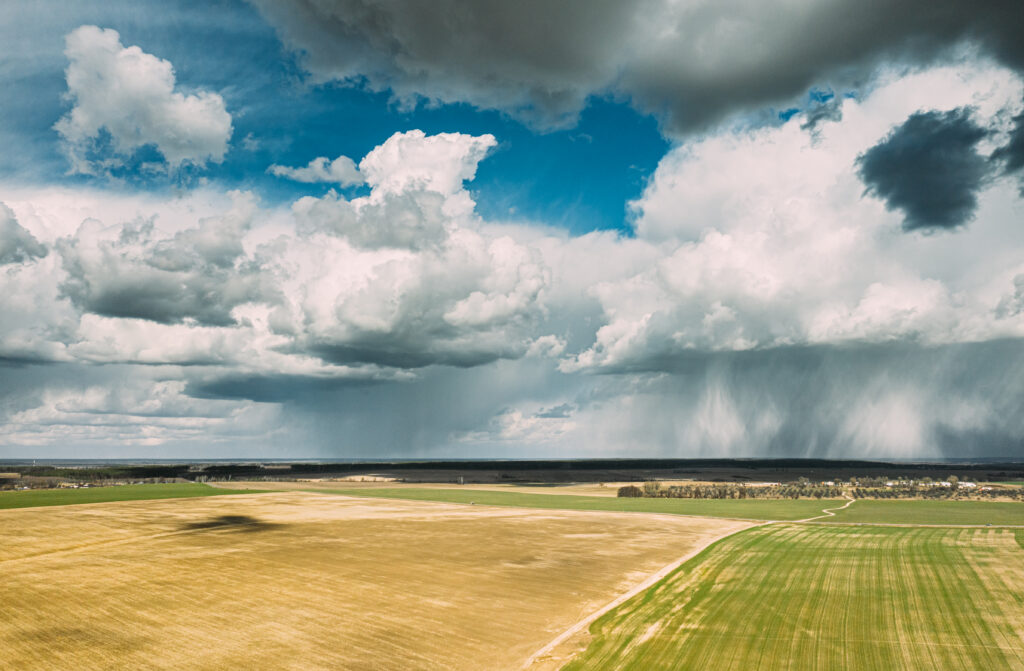
Stories of weather manipulation tap into a deep cultural fascination: the ability to control forces that are vast, uncontrollable, and vital to human life. These narratives suggest that governments or shadowy elites are able to induce hurricanes, floods, droughts, or extreme temperatures for political, economic, or military purposes.
While humans have developed limited influence over local weather—through cloud seeding, for example—global or catastrophic weather control remains beyond our technological reach. Nevertheless, weather control conspiracy narratives persist, blending scientific reality with cultural anxiety and distrust of authority.
Historical roots
Weather manipulation fears are not new. They emerged alongside real experiments and technological advances:
- Cold war era experiments: during the 1960s and 1970s, programs like Project Stormfury attempted hurricane modification through cloud seeding. While scientifically limited, these experiments provided early fodder for speculation.
- Vietnam war (Operation Popeye): the US military seeded clouds over parts of Vietnam to extend the monsoon season, aiming to disrupt enemy supply lines. The operation’s existence proved that military-directed weather modification was at least conceptually possible, amplifying fears.
- Soviet weather experiments: the USSR also explored cloud seeding and ionospheric modification, often shrouded in secrecy, contributing to the perception of global technological capabilities.
These historical cases, while modest in scale and effect, provided the scaffolding for narratives of total environmental control.
Modern technological misinterpretations
Modern narratives often incorporate real technologies, magnifying their potential:
- HAARP (High-Frequency Active Auroral Research Program): originally designed for ionospheric research, HAARP became a lightning rod for conspiracy theorists claiming it could trigger earthquakes, hurricanes, or floods.
- Geoengineering research: climate scientists exploring solar radiation management or stratospheric aerosol injection inadvertently feed speculation. Discussions of potential planetary-scale interventions are often interpreted as already implemented covertly.
- Military weather capabilities: modern discussions of hurricane tracking, satellite surveillance, and atmospheric modelling are frequently conflated with intentional manipulation.
Patterns in conspiratorial thinking
Weather control narratives follow familiar patterns found in other conspiracy theories:
- Centralized intent: a small group of powerful actors is assumed to orchestrate large-scale environmental events.
- Global reach: catastrophes anywhere in the world are linked to the same actors.
- Opacity equals malice: lack of public knowledge or scientific transparency is interpreted as evidence of secret programs.
- Event attribution bias: natural disasters are routinely attributed to manipulation rather than natural variation.
These narratives are compelling because weather is high-stakes, visible, and uncontrollable. Humans naturally seek agency in unpredictable environments.
Social media and amplification
Platforms like YouTube, Telegram, and alternative forums accelerate weather control narratives through viral videos of extreme weather events interpreted as “proof”. The algorithms amplify sensational claims, and communities share this “evidence” and co-create theories.
The digital environment transforms isolated mis-perceptions into collective belief, reinforcing group cohesion around the idea of secret atmospheric control.
Psychological drivers
Belief in weather control often reflects anxiety about climate change (extreme events feel personal and deliberate) and distrust of institutions (governments, military agencies, and corporations are perceived as unaccountable).
These drivers mirror those behind chemtrails, geoengineering fears, and other environmental conspiracies.
A reality check
While humans have experimented with weather modification at small scales, the notion of global manipulation remains unfeasible. Hurricanes, droughts, and tornadoes are driven by complex, chaotic systems beyond human control. Cloud seeding works in limited contexts but cannot alter weather at continental scales. All in all, climate intervention proposals remain theoretical, with no documented global deployment.
Yet, narratives persist because they resolve uncertainty and assign accountability. They reveal how humans interpret uncontrollable natural events as directed and deliberate.
For organisations navigating misinformation, public fear, or reputational risk tied to environmental narratives, Negative PID provides actionable digital investigations and risk intelligence to clarify claims, available at https://negativepid.com/services.