







The internet has not only changed how people communicate, but also how they radicalize, mobilize, and believe. In the digital world, political and ideological subcultures thrive in algorithms and anonymous forums. And they evolve into powerful social forces that shape elections, riots, and revolutions.
What once started as fringe discussions on message boards has become the backbone of modern political discourse, often distorted by memes, conspiracy theories, and digital tribalism.
Digital ideologies: where do they come from?
Political discourse has always existed online, but its tone and structure changed dramatically in the mid-2000s. Between the 90s and the early 2000s, Usenet forums, personal blogs, and email chains spread early libertarian and anarchist ideas.
Starting around 2006, anonymous imageboards like 4chan (/b/, /pol/) incubated troll-based, ironic engagement with politics. By 2020, the Internet saw the rise of populism, meme warfare, and decentralized movements like the alt-right and Antifa.
More recently, we are watching the rise of conspiracy ecosystems like QAnon, state-backed propaganda, and ideological grifters on platforms like X, YouTube, and Telegram.
Alt-Right and manosphere
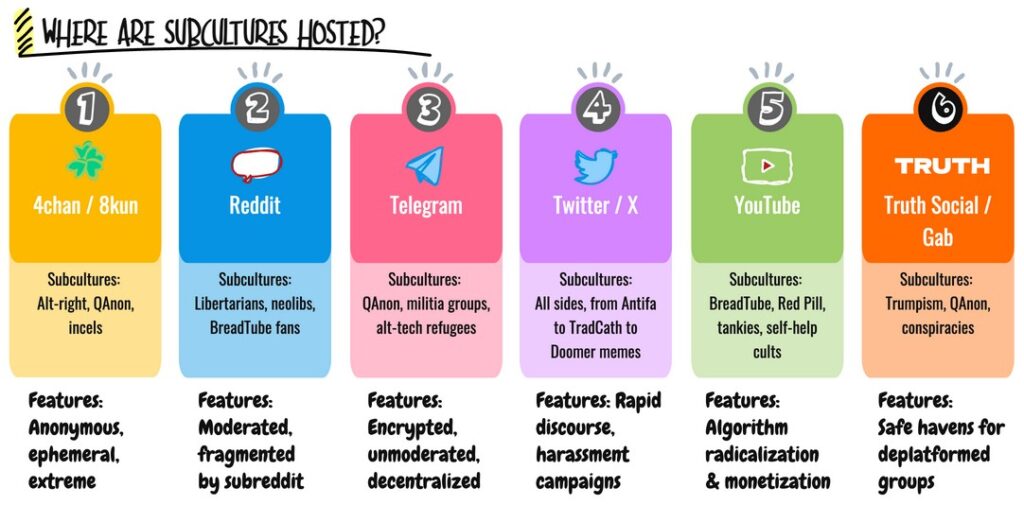
Alternative social media like 4chan (/pol/), Gab, Telegram, Reddit (before the bans), and X host groups with anti-globalism, racial nationalism, and traditional gender role beliefs. They are known for their meme warfare tactics, dog-whistling, and ironic extremism. These groups have adopted symbols like Pepe the Frog (co-opted), the OK sign, and Wojak variants.
- Alt-right is a right-wing ideological movement based in the United States, characterized by a rejection of mainstream politics and by the use of online media to disseminate provocative content, often expressing opposition to racial, religious, or gender equality.
- The manosphere is a varied collection of websites, blogs, and online forums promoting masculinity, misogyny, and opposition to feminism. Communities within the manosphere include men's rights activists, incels, Men Going Their Own Way, pick-up artists, and fathers' rights groups.
Incels and Blackpills communities
These groups have a fatalistic view of dating, where women are hypergamous and genetic determinism is spread. Their ideology has links to misogyny and radicalization into violent extremism. They often overlap with alt-right, Red Pill, and “MGTOW” (Men Going Their Own Way) subcultures.
- An incel is a member of an online subculture of mostly male and heterosexual people who define themselves as unable to find a romantic or sexual partner despite desiring one. They often blame, objectify and denigrate women and girls as a result.
- The term black pill, first popularized in the 2010s on the incel blog Omega Virgin Revolt, refers to accepting the futility of fighting against a feminist system. Blackpilled incels are encouraged to either commit suicide or “go ER”/be a “hERo,” referencing Elliot Rodger’s 2014 Isla Vista murder.
Qanon and Conspiracy subcultures
The narratives of these groups spread myths about global pedophile rings, the Deep State, and see Donald Trump as a messiah figure. They feature recruitment techniques that involve gamified drops, citizen investigations, and cryptic “Q drops.” Started on mainstream social media platforms, they have migrated to Gab, Truth Social, and Telegram after being banned.
- QAnon is a far-right American political conspiracy theory and political movement that originated in 2017. QAnon centers on fabricated claims made by an anonymous individual or individuals known as "Q". Those claims have been relayed and developed by online communities and influencers.
- Conspiracy subculture refers to a group or community of people who share a belief in conspiracy theories and actively promote or participate in the spread of these theories. These subcultures often have their own distinct language, symbols, and social networks. They can range from loosely connected online communities to more tightly-knit groups with shared offline activities.
Breatube and leftTube
These groups promote socialism, antifascism, and critiques of capitalism and hierarchy. Among their influencers, they feature ContraPoints, Philosophy Tube, Vaush, and HasanAbi. Their tactics include debunking right-wing content via long-form videos on YouTube and TikTok.
- BreadTube refers to an informal group of left-wing YouTubers who create video essays and educational content with socialist, communist, anarchist, and other left-leaning perspectives. They often address topics and themes also covered by far-right figures on YouTube, aiming to counter their narratives and reach a wider audience through algorithmic "hijacking".
- "LeftTube" is an informal term, sometimes used interchangeably with "BreadTube", that refers to a loose group of left-leaning YouTube creators who offer commentary, analysis, and educational content from socialist, communist, anarchist, and other leftist perspectives. These creators often discuss political and social issues, using video essays and other formats, and aim to engage with and counter right-wing narratives on YouTube.
Antifa and Black bloc communities
These communities host decentralized anarchist and antifascist action networks. They are known for doxing, counter-protests, and cyberactivism. They are often accused of inciting violence, but they operate without a central leadership.
- Antifa, short for anti-fascist, is a decentralized, left-leaning political movement that opposes fascism, racism, and other forms of far-right extremism. It's not a single organization, but rather a network of autonomous groups and individuals who engage in various forms of activism, including both non-violent and violent direct action.
- A black bloc is a radical anarchist group whose members dress all in black and conceal their identities when protesting.
Tankies and Marxist-Leninists
These groups promote authoritarian leftist support (e.g., China and USSR nostalgia). They are known for their irony, propaganda remixing, and calls for class war. They often clash with the liberal or anarchist left.
- Tankie is a pejorative label generally applied to authoritarian communists, especially those who support or defend acts of repression by such regimes, their allies, or deny the occurrence of the events thereof.
- Marxism-Leninism is a political and economic ideology (a development of Marxism) emphasizing the need for a vanguard party to lead a socialist revolution and establish a communist state. It was further developed by Vladimir Lenin and Joseph Stalin. Online, it manifests as various groups and individuals who adhere to these principles, engaging in discussions, propaganda, and organization within online spaces.
Sovereign citizens and anarcho-libertarians
These groups reject the legitimacy of the government, taxes, or law enforcement. Typical behaviours are legal “word magic,” court disruptions, and self-issued IDs. They have been flagged by agencies as potential domestic terror threats.
- The sovereign citizen movement is a loose group of anti-government activists, conspiracy theorists, vexatious litigants, tax protesters and financial scammers found mainly in English-speaking common law countries—the United States, Canada, Australia, the United Kingdom, and New Zealand.
- Anarcho-libertarianism, also known as anarchist libertarianism, is a political philosophy that combines elements of both anarchism and libertarianism. It advocates for a society without a state (anarchism) and with maximum individual liberty and minimal government intervention (libertarianism), particularly in the economic sphere. This often translates to a strong emphasis on individual rights, free markets, and voluntary cooperation.
Common Tactics of digital ideology
One of the characteristics of digital ideology is its effectiveness in recruiting new followers. This is commonly done by using one or a combination of the following tactics:
- Meme Propaganda: Condensed ideological beliefs into humor or symbolism.
- Irony Shielding: “Just joking” layers to disguise real intentions.
- Mass Reporting / Brigading: Weaponizing platform policies.
- Flooding / Spamming: Overwhelm hashtags with narrative.
- Deplatforming Resistance: Migration to alt-tech (e.g., Rumble, BitChute).
- Gamification: Q drops, ARG-style clues, or “red-pilling” newcomers.
The role of memes in ideological recruitment
Memes, in particular, play a major role in recruiting new followers. They serve as ideological entry points, using humour or emotion to lower defences. For instance:
The NPC meme
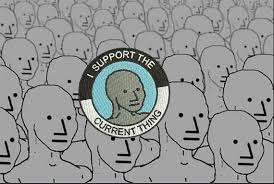
NPC stands for Non-Playable Character, a term from video games referring to characters controlled by the game’s script rather than by players. In meme culture, calling someone an “NPC” implies they are unthinking, repeat mainstream or scripted opinions, lack original or critical thought, and are part of the “herd.” It’s essentially calling someone a mindless conformist. The meme is powerful because it’s dehumanizing without being overtly violent.
Based vs. Cringe
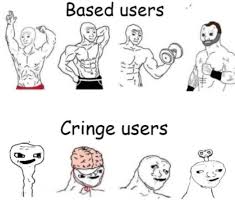
“Based vs. Cringe” memes compare two behaviours, people, or ideas using strong visual contrast: for example, cringe people use pronouns in their social media biographies, follow mainstream media, and submit to authorities; based people say what they think, watch independent creators, and challenge the narrative. “Based” is used to describe traditional masculinity, anti-feminism, or nationalism. This format is simple, viral, and emotionally loaded: it reduces complex discourse to moral dichotomies.
Clown World
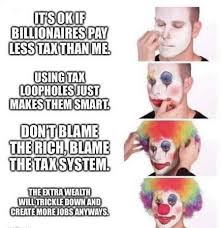
“Clown World” is a meme and catchphrase used to express the belief that society has become irrational, backwards, or absurd. It’s like living in a circus run by clowns. It implies that traditional values or logic have been replaced by chaos or nonsense, social progress or inclusivity is ridiculous or performative, and you (the viewer) are a sane observer in an insane world. It’s often used to dismiss political, social, or cultural developments with a sneer of nihilistic humour.
These memes often lead users from mild contrarianism to radical ideologies, a pattern known as the radicalization funnel.
The roles of algorithms in radicalizing the Internet
YouTube, Facebook, and X have been criticized for algorithmic radicalization. They do that by recommending increasingly extreme content, forming echo chambers, and prioritizing engagement over the truth. As a result, ideological subcultures can self-reinforce without exposure to counterarguments.
From a cybersecurity perspective, for analysts and investigators, these groups present complex threats. They constitute social engineering vectors (e.g., phishing via identity politics), they use encrypted communication channels (such as Telegram and Matrix), and they engage in cross-platform migrations when they are banned from one community. They also foster deepfake propaganda and pose a risk of violence, like in the case of the Christchurch attack.
The Internet and Social Media platforms' ethical dilemmas
Should platforms censor ideology? Can irony be policed? Should governments intervene?
There are ongoing debates around deplatforming and decentralization, free speech vs. hate speech, algorithmic responsibility, and the psychosocial impact on youth.
The Internet is an ideological battleground. Political and ideological subcultures thrive in the Internet’s chaotic terrain. Whether meme-based or manifesto-driven, these groups illustrate how beliefs mutate in digital spaces, shaped by anonymity, algorithms, and aesthetics.
For digital investigators and cultural analysts alike, understanding these groups is key to navigating the future of online discourse, influence operations, and security.