












What if humans could leave their bodies behind and live through their conscience altogether? If this sounds like a plot of a sci-fi movie, it’s not. It’s the essence of Project 2045, also known as the 2045 Initiative. Founded by a Russian entrepreneur and backed by scientists and technology enthusiasts all over the world, Project 2045 is at the forefront of trans-humanist theories and is gaining momentum. But is it really feasible?
What is Project 2045?
Founded in February 2011 by Russian entrepreneur Dmitry Itskov, the 2045 initiative is organized as a nonprofit organization aiming to extend human life through technology, merging spirituality, culture, ethics, science and innovation.
The initiative promotes the Avatar Project, which envisions transferring human consciousness into non-biological carriers, ultimately aiming for cybernetic immortality by around the year 2045.
The 2045 Manifesto
Mankind has turned into a consumer society standing at the edge of a total loss of the conceptual guidelines necessary for further evolution. The majority of people are almost exclusively absorbed in merely maintaining their own comfortable lives.
Modern civilization, with its space stations, nuclear submarines, iPhones and Segways cannot save mankind from the limitations in the physical abilities of our bodies, nor from diseases and death.
We are not satisfied with modern achievements of scientific and technical progress. Science working for the satisfaction of consumer needs will not be able to ensure a technological breakthrough towards a radically different way of life.
We believe that the world needs a different ideological paradigm. Within its framework it is necessary to form a major objective capable of pointing out a new direction for the development of all mankind and ensuring the achievement of a scientific and technical revolution.
The new ideology should assert, as one of its priorities, the necessity of using breakthrough technology for an improvement of man himself and not only of his environment.
We believe that it is possible and necessary to eliminate aging and even death, and to overcome the fundamental limits of the physical and mental capabilities currently set by the restrictions of the physical body.
Scientists from various countries in the world are already developing technology that ensures the creation of an artificial human body prototype within the next decade. We believe the biggest technological project of our times will become the creation of such artificial human body and a subsequent transfer of individual human consciousness to such a body.
Implementation of this technological project will inevitably result in an explosive development of innovations and global changes in our civilization and will improve human life.
We believe that before 2045 an artificial body will be created that will not only surpass the existing body in terms of functionality, but will achieve perfection of form and be no less attractive than the human body. People will make independent decisions about the extension of their lives and the possibilities for personal development in a new body after the resources of the biological body have been exhausted.
The new human being will receive a huge range of abilities and will be capable of withstanding extreme external conditions easily: high temperatures, pressure, radiation, lack of oxygen, etc. Using a neural-interface humans will be able to operate several bodies of various forms and sizes remotely.
We suggest the implementation of not just a mechanistic project to create an artificial body, but a whole system of views, values and technology which will render assistance to humankind in intellectual, moral, physical, mental and spiritual development.
We invite all interested specialists: scientists, politicians, mass media personalities, philosophers, futurologists and businessmen to join the “2045” strategic social initiative. We welcome all who share our vision of the future and are ready to make the next jump.
The main objectives of our movement are:
1. To achieve the support of the International community and create conditions for international co-operation of interested specialists around the “2045” Initiative.
2. To create an international research center for cybernetic immortality to advance practical implementations of the main technical project – the creation of the artificial body and the preparation for subsequent transfer of individual human consciousness to such a body.
3. To engage experts in the selection and support of the most interesting projects in the quest to ensure technological breakthroughs.
4. To support innovative industries and create special scientific education programs for schools and institutes of higher education.
5. To create educational programs for television, radio and internet, to hold forums, conferences, congresses and exhibitions, and to establish awards and produce books, movies and computer games with the view of raising the profile of the initiative and spreading its ideas.
6. To form a culture connected with the ideology of the future, promoting technical progress, artificial intellect, “multi-body”, immortality, and cyborgization.
What is post-humanism?
- Posthumanism is a philosophical, cultural, and ethical framework that questions what it means to be “human” and explores ways humanity might evolve beyond current biological and social limitations.
Posthumanism challenges the idea that humans are at the center of everything (anthropocentrism) and explores scenarios where humans merge with technology, AI, or other species. This philosophy envisions a post-human condition, such as beings that are not limited by current human biology, cognitive abilities or lifespan.
Post-humanism stems from trans-humanism, which is the practical pursuit of human enhancement through technology (such as technology non-medical implants).
The avatar roadmap
Project 2045 fits perfectly into the posthumanist perspective, because it envisions a future where “humans” are no longer bound to flesh bodies or even biological substrates. It does that through the Avatar Project, with precise milestones detailing this process:
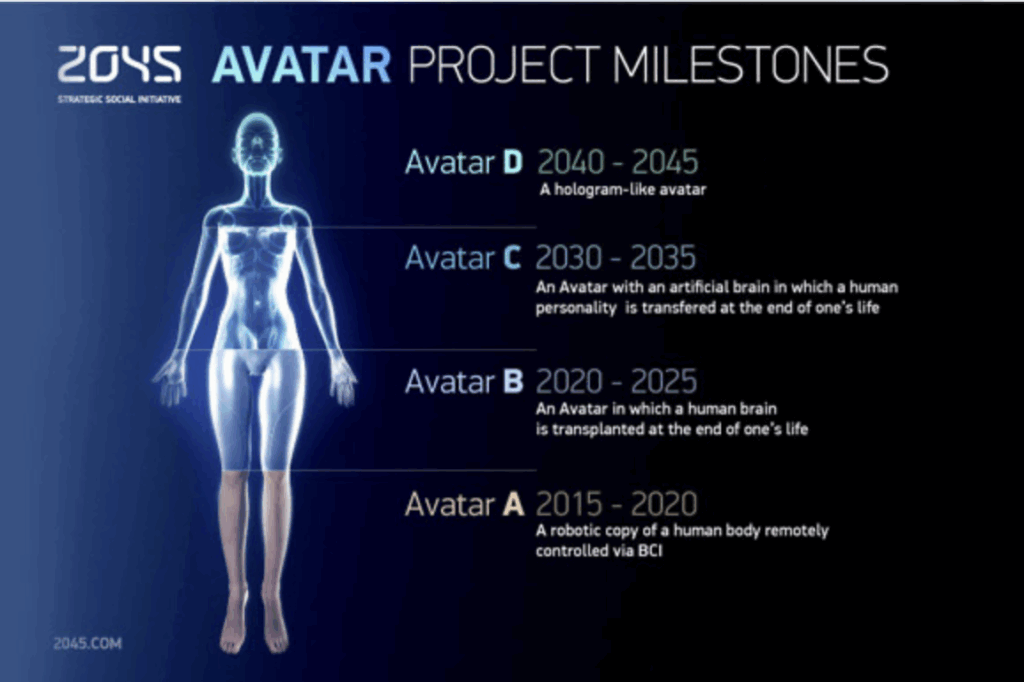
- Avatar A (2015-2020): Develop a robotic humanoid ("avatar") controlled via a brain-computer interface. As of now, there's no evidence that this milestone was fully realized.
- Avatar B (2020-2025): Transfer a human brain into an artificial body, maintaining its function via an integrated life-support system. This milestone has not been achieved either.
- Avatar C (2030-2035): Create an artificial brain capable of housing a human personality, effectively emulating the individual's consciousness.
- Avatar D (2040-2045): The ultimate goal: a hologram-like or substrate-independent avatar, liberated from physical form.
Neuroscience and technical challenges
The boldest claims of the 2045 Initiative rest on breakthroughs in mind uploading and substrate-independent consciousness.
However, the objectives claimed in the Avatar project milestones have not been met for several reasons. The challenges span multiple fields of research:
- Brain mapping: the human brain has ~86 billion neurons with trillions of synapses. We lack the technology to map and simulate this complexity at scale. Even small organisms (like the C. elegans worm with 302 neurons) have only recently been simulated partially.
- Brain-Computer interfaces (BCIs): projects like Neuralink, Kernel, and DARPA's Next-Generation Nonsurgical Neurotechnology (N3) are working on higher-bandwidth interfaces. Today's BCIs can restore limited movement in paralyzed individuals or control robotic limbs, but they transmit very low data rates compared to the brain natural throughput.
- Whole brain emulation: the roadmap assumes we can one day copy or emulate consciousness. Defining consciousness, capturing individual personality, avoiding "information loss," and storage requirements in the estimate of 1 exabyte to 1 zettabyte to emulate human brain are the main challenges.
- Artificial bodies and avatars: robotics has advanced (just look at Boston Dynamics humanoids or Japan's cybernetic exoskeletons), however, we're far from seamless integration with human neural control.
At the current state of technology and neurology, the vision of Project 2045 still seems very far. However, we might not be very far from a breakthrough.
Quantum computing and AI
Quantum computing could, in theory, be a key accelerator for some Project 2045. Indeed, it could provide exponential speedups in simulating complex systems (like protein folding, or potentially neural networks at the synaptic scale).
Also, the role of AI could boost the project significantly: quantum machine learning (QML) could accelerate pattern recognition and cognitive modelling, making it more feasible to create a “digital twin” of a human brain.
However, the different scenarios resulting from the advancement in these two fields are still speculation.
Is Project 2045 unique?
Project 2045 is Russian-led and unique in its scope and storytelling. It is the most publicly packaged immortality roadmap, but it’s not the only attempt to extend human life through tech.
There are indeed parallel efforts worldwide in the U.S., EU, China, and Asia focusing on parts of the puzzle: brain mapping, longevity, BCIs, robotics, and AI. None is as explicitly marketed as a step-by-step “immortality roadmap,” but collectively they cover much of the same ground.
While Project 2045 evokes sci-fi scenarios, reality might not be that far behind, bringing a lot of philosophical and ethical questions on how humans will evolve with the help of technology.