











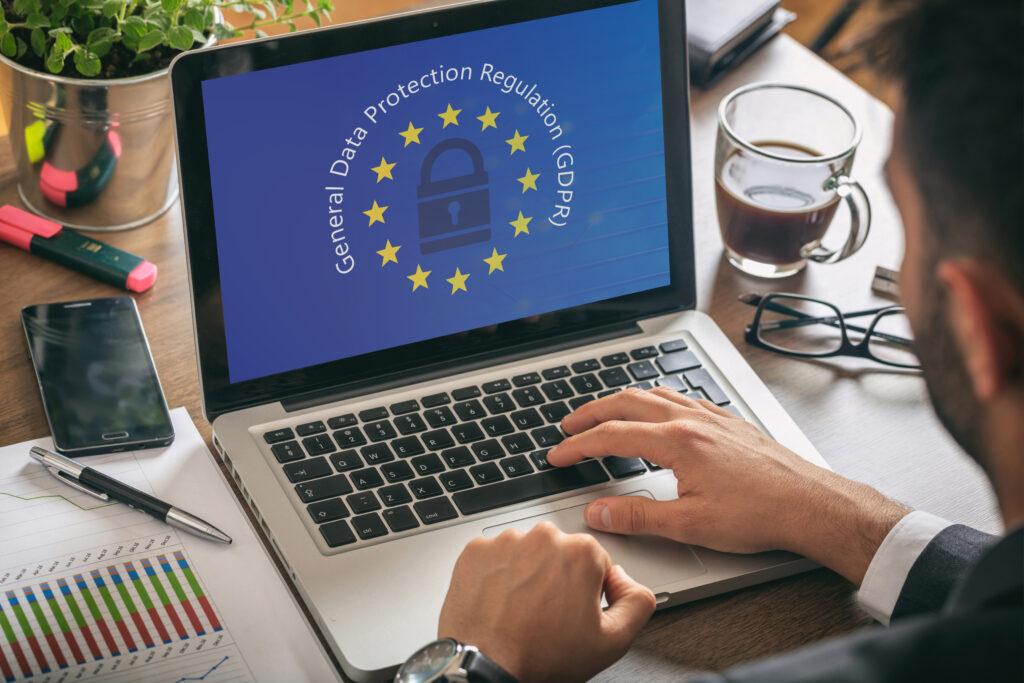
You’ve seen it a hundred times, that polite little pop-up asking if you’ll accept cookies before you can read an article or shop online. Most people assume it’s there because of the GDPR, Europe’s sweeping data privacy law. But that’s only half the story. Those banners actually come from a separate rule — the ePrivacy Directive — while the GDPR governs something much broader: how personal data is collected, stored, and used.
What is GDPR?
Since it came into force in 2018, the GDPR has become the world’s toughest privacy framework, reshaping how companies everywhere handle information. And although it’s an EU law, its reach doesn’t stop at Europe’s borders: it applies to any organization that processes data from individuals located in the EU, no matter where that organization is based.
- The General Data Protection Regulation (GDPR) is a comprehensive data protection and privacy regulation that was implemented by the European Union (EU) on May 25, 2018. It is designed to strengthen and unify data protection for all individuals within the EU, as well as address the export of personal data outside the EU.
- For individuals, this translates into real rights: to know what data is held about them, to have it corrected or erased, and even to move it to another provider.
- For companies, it means accountability: they must be able to prove compliance, not just claim it.
You will find more information at GDPR.EU.
Why is GDPR important?
Its global reach is what makes GDPR so significant, and, for many businesses, so challenging. GDPR introduced strict rules about consent, transparency, and accountability, giving individuals unprecedented control over their personal data. Companies must be clear about what they collect and why, and they can face steep fines for getting it wrong.
Beyond the legal obligations, GDPR forced organizations to rethink privacy not just as a compliance issue, but as a fundamental right, as a foundation of digital trust and user confidence.
Before GDPR, each EU member state had its own data protection laws, which led to inconsistencies and complexities. GDPR harmonizes these laws across the EU.
Who must comply with GDPR?
All companies operating within the European Union must comply with GDPR. However, you might not know that even businesses operating outside the European Union are subject to the regulation.
- If you're marketing your goods and services to individuals located in the EU, or monitoring their behaviour, you must comply with GDPR, even if your business is based outside the EU.
The regulation protects anyone located in the European Union when their data is collected or processed, regardless of their nationality.
That means a Canadian retailer, a U.S. social media platform, or an Australian app developer must comply if they’re targeting people in the EU, whether by offering goods, services, or even just tracking user behaviour for analytics or advertising.
This extraterritorial reach has made GDPR a global benchmark. Governments from Brazil to Japan have since modelled their own data protection laws on its framework, changing how the digital economy treats privacy.
For organizations outside the EU, the safest approach is to treat GDPR as a blueprint for trust. Following its principles can strengthen customer confidence everywhere.
The key principles of GDPR
The regulation is built around a few key principles that shape how organizations can collect and use that data:
- Lawfulness, fairness, and transparency: data must be collected in a way that’s legal, honest, and clear to the individual. No hidden tracking, no buried consent boxes.
- Purpose limitation: information should only be used for the specific reason it was collected and not stored indefinitely “just in case.”
- Data minimization: businesses are expected to collect only what’s necessary to provide their service, nothing more.
- Accuracy and storage limitation: data should be kept up-to-date and deleted when it’s no longer needed.
- Integrity and confidentiality: security isn’t optional. Organizations must protect personal data from loss, misuse, or unauthorized access.
GDPR in practice
For most businesses, GDPR compliance starts with one simple question: What personal data are we collecting, and why?
This will lead you to take a deeper look at everyday practices: sign-up forms, analytics tools, mailing lists, and even employee records.
In practice, complying with GDPR means:
- Mapping your data: understanding where personal data comes from, where it’s stored, and who has access to it.
- Revisiting consent: making sure people actively agree to how their data is used, with clear and specific language instead of vague “accept all” boxes.
- Updating privacy notices: explaining, in plain terms, what information is collected, how it’s used, and for how long it’s kept.
- Securing your systems: implementing encryption, access controls, and regular security assessments to protect against breaches.
- Being prepared to respond: GDPR gives individuals rights to access, correct, or delete their data, and organizations must have a process to handle those requests quickly.
Penalties for non-compliance
- Non-compliance with GDPR can result in significant penalties, including fines of up to €20 million or 4% of the company's global annual turnover, whichever is higher. Additionally, companies may face reputational damage and legal actions from individuals whose data has been mishandled.
The bigger picture: Privacy as a shared responsibility
Privacy isn’t a European concept: it’s a universal expectation for anybody who has an online presence. GDPR was necessary to remind the world that personal data isn’t a business asset. It’s something deeply personal, tied to identity, autonomy, and trust.
Artificial intelligence, biometric tracking, and cross-border data flows are already testing the limits of existing laws. GDPR sets the pace for what responsible digital governance should look like.