











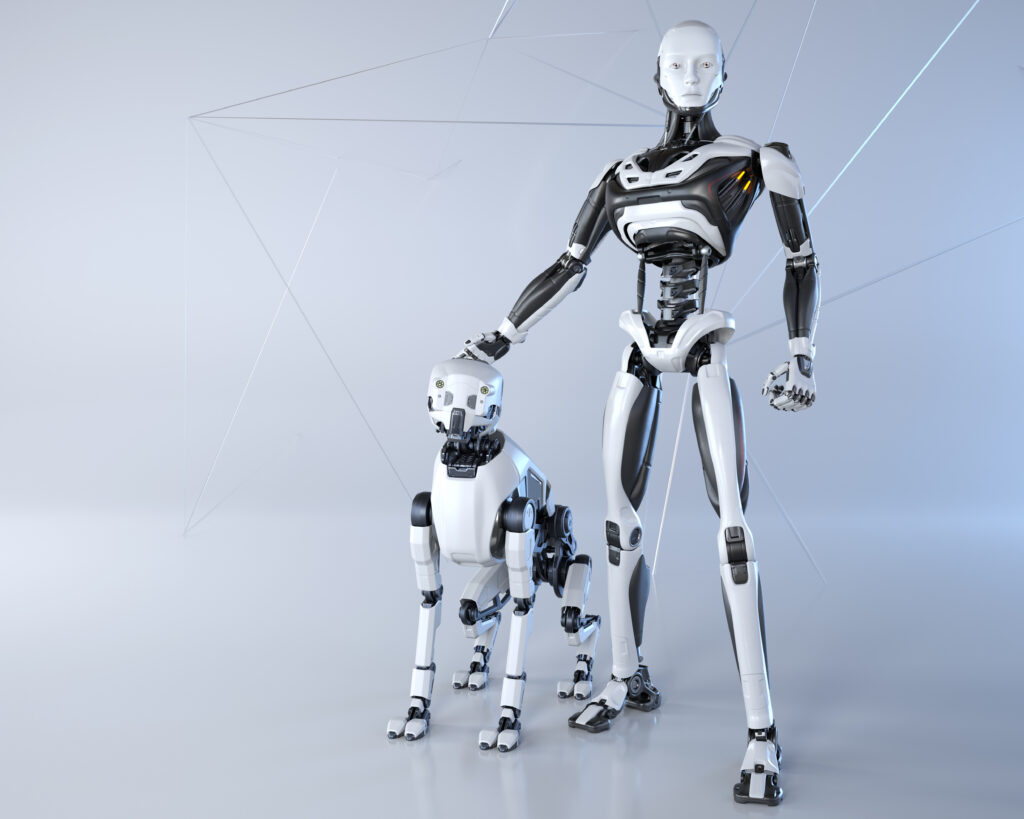
If hardware gives robots their bodies, artificial intelligence gives them their behaviour. AI is a game changer for robotics: without it, most robots remain predictable, confined to repetitive tasks in controlled environments. With it, they begin to interpret the world, adapt to uncertainty, and make decisions that were once reserved for humans.
This convergence, between physical machines and learning systems, is what defines modern robotics.
From pre-programmed to adaptive systems
Traditional robots operate on fixed instructions. Every movement is defined in advance, every outcome anticipated. This works well in stable environments like assembly lines, where variation is minimized.
AI changes that model.
Instead of relying solely on predefined rules, robots can now process sensor data in real time and adjust their actions accordingly. A warehouse robot, for example, no longer needs a fixed path. It can navigate dynamically, avoid obstacles, and optimize its route based on current conditions.
This shift from deterministic behaviour to probabilistic decision-making is fundamental. It introduces flexibility, but also uncertainty.
The core capabilities that AI brings to robotics
Artificial intelligence enhances robotics in three key areas: perception, decision-making, and learning.
Perception
Perception allows robots to understand their environments. Through computer vision and sensor fusion, robots can interpret complex spaces. Cameras, depth sensors, and LiDAR feed data into AI models that identify objects, estimate distances, and detect motion.
Frameworks developed by organizations like OpenAI and DeepMind have accelerated advances in perception, particularly in image recognition and spatial reasoning.
Decision-making
Once a robot understands its environment, it must decide what to do. AI enables planning under uncertainty, balancing multiple possible actions and outcomes.
This is especially important in dynamic environments where conditions change rapidly. A delivery robot navigating a crowded street must continuously reassess its path, accounting for pedestrians, obstacles, and timing.
Learning
Machine learning allows robots to improve through experience. Instead of relying entirely on human programming, systems can refine their behaviour based on feedback.
Reinforcement learning, in particular, has been used to train robots in simulated environments before deploying them in the real world. Companies like Boston Dynamics use simulation extensively to teach robots how to walk, balance, and interact with objects.
Simulation Vs reality
Training robots in simulation is efficient and scalable. Virtual environments allow millions of scenarios to be tested quickly without physical wear or risk. However, transferring that learning to the real world is not straightforward.
This challenge, often called the “sim-to-real gap,” arises because simulations cannot perfectly replicate reality. Small discrepancies in physics, lighting, or surface conditions can lead to unexpected behaviour when a robot is deployed.
Bridging this gap remains one of the central challenges in AI-driven robotics.
The role of software frameworks
Modern robotics depends heavily on software ecosystems that integrate AI with hardware. Platforms like ROS provide a modular architecture for building robotic systems. They allow developers to combine perception, planning, and control components into a unified system.
This modularity accelerates development but also introduces complexity. Each component, from sensor drivers to AI models, becomes a potential point of failure.
How much decision-making is too much?
How much autonomy should robots have? Fully autonomous systems can operate without human intervention, but they also reduce human oversight. In safety-critical environments, this trade-off becomes significant.
For example:
- In healthcare, an assistive robot must balance autonomy with strict safety constraints.
- In logistics, autonomy improves efficiency but requires safeguards to prevent collisions or errors.
- In public spaces, unpredictable human behaviour complicates decision-making.
Many systems adopt a hybrid approach, combining autonomous operation with human supervision. This allows robots to handle routine tasks while escalating complex or ambiguous situations.
New risks of AI in the physical world
AI introduces a new category of risk in robotics. Unlike traditional software systems, robots interact directly with the physical environment.
This creates new challenges. The most obvious is unpredictability: AI models can behave in unexpected ways, especially when encountering unfamiliar scenarios. In a physical system, this can lead to accidents or damage.
Security vulnerabilities are another pain point: robots connected to networks can be targeted like any other digital system. A compromised robot is not just a data breach, it is a physical risk.
And finally, data integrity poses another major risk: AI systems rely on data for training and operation. Manipulated or biased data can lead to incorrect decisions, with real-world consequences.
AI-powered robots need robust testing, monitoring, and cybersecurity practices in robotics deployments.
The illusion of intelligence
Despite rapid progress, it is important to recognize the limitations of current AI systems. Robots do not “understand” the world in the way humans do. They detect patterns, optimize decisions, and respond to inputs, but their intelligence is narrow and task-specific.
A robot trained to sort packages cannot suddenly perform a different task without retraining. Even advanced systems struggle with generalization, the ability to apply knowledge across different contexts.
This gap between perceived intelligence and actual capability often leads to overestimation of what robots can do.
Where is this heading?
The integration of AI and robotics is still in its early stages. However, robots are becoming more adaptable, more autonomous, and more integrated into complex environments.
Future developments will likely focus on improving generalization across tasks, reducing the sim-to-real gap, enhancing safety and reliability in unpredictable environments, and strengthening security in connected robotic systems.
As robots gain the ability to perceive and decide, they move closer to operating alongside humans in everyday environments. This raises new questions, not just about capability, but about trust, safety, and control.
Next week, we’ll move from intelligence to impact, examining how robots are transforming industries, starting with warehouses, factories, and logistics systems where automation is already reshaping work.