











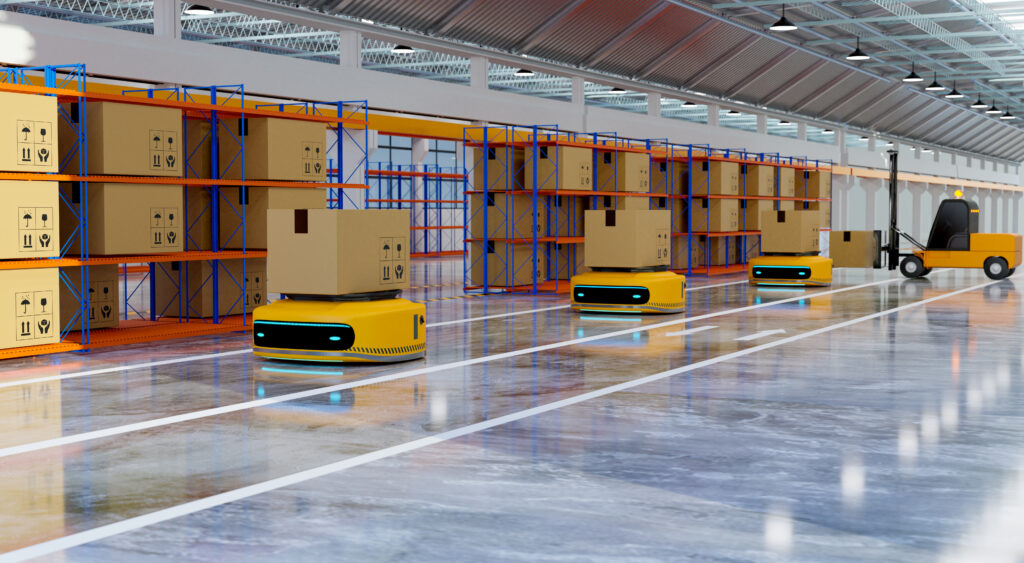
When most people think about robots in the workplace, they imagine a factory floor filled with robotic arms assembling cars. While industrial manufacturing remains one of robotics’ largest applications, today’s robotic workforce extends far beyond assembly lines. Warehouses, distribution centres, shipping facilities, and logistics networks are increasingly populated by machines that move, sort, lift, transport, and collaborate alongside human workers.
The rise of automation
The growth of e-commerce, global supply chains, labour shortages, and consumer expectations for rapid delivery have created powerful incentives for automation. Companies are turning to robotics not only to reduce costs but also to improve efficiency, safety, and scalability. The result is a transformation of how goods move from manufacturer to customer.
The evolution of industrial robotics
Industrial robots have been a fixture of manufacturing for decades. Early systems were designed to perform repetitive, high-precision tasks such as welding, painting, and assembly. These machines excelled because they could work continuously with minimal variation and exceptional accuracy.
Traditional industrial robots, however, operated within strict limitations. They required carefully controlled environments, safety cages, and highly predictable workflows. Any unexpected change could halt production or create safety risks.
Modern robotics is expanding beyond these constraints. Advances in sensors, artificial intelligence, and machine vision now allow robots to operate in more dynamic environments and interact more safely with humans. Instead of simply repeating programmed motions, robots increasingly adapt to changing conditions in real time.
The rise of warehouse robotics
Warehousing and fulfillment operations have embraced robotics aggressively. The rapid growth of online retail has created enormous pressure on distribution networks. Consumers expect same-day or next-day delivery, forcing companies to process orders faster than ever before.
To meet these demands, warehouses are deploying fleets of autonomous mobile robots (AMRs) capable of transporting inventory throughout facilities.
Unlike traditional conveyor systems, AMRs can navigate independently. They avoid obstacles, reroute around congestion, and coordinate with other machines to optimize workflow.
Modern warehouses often resemble coordinated ecosystems where humans and robots work together. A typical robotic warehouse may include:
Together, these technologies significantly reduce the time required to fulfill customer orders.
Factories become smarter
Manufacturing facilities are undergoing their own transformation. The concept of the “smart factory” combines robotics, sensors, connectivity, and data analytics to create highly responsive production environments.
Rather than operating as isolated machines, robots increasingly function as part of interconnected systems.
Production lines can automatically adjust based on demand forecasts, inventory levels, or equipment performance. Robots communicate with other machines, inventory systems, and operational software to optimize production efficiency.
This connectivity enables manufacturers to:
- Reduce downtime through preditcive maintenance
- Improve product quality through continuous monitoring
- Increase production flexibility
- Respond more quickly to market changes
The goal is no longer automation, but intelligent automation.
Human-robot collaboration
One of the most significant developments in workplace robotics is the emergence of collaborative robots, often called cobots. Unlike traditional industrial robots, which typically operate behind safety barriers, cobots are designed to work alongside human workers.
They assist with tasks such as:
- Lifting heavy objects
- Repetitive assembly work
- Material handling
- Inspection and quality assurance
By handling physically demanding or repetitive activities, cobots can reduce worker fatigue and lower the risk of workplace injuries. This collaborative model reflects an important reality. In many situations, robots are not replacing humans entirely. Instead, they are augmenting human capabilities.
Humans remain better at problem-solving, adaptability, and complex decision-making. Robots excel at consistency, precision, and endurance. The combination can be highly effective.
The labour question
The expansion of robotics inevitably raises concerns about employment. Throughout history, technological advances have disrupted labour markets. Robotics is no exception.
Some tasks are becoming increasingly automated, particularly those involving repetitive, predictable activities. Warehousing, manufacturing, and logistics have seen significant reductions in the need for certain manual roles. At the same time, robotics creates new categories of work.
Organizations require technicians, engineers, software developers, maintenance specialists, cybersecurity professionals, and operational analysts to support robotic systems.
The question is how work changes and whether workers can successfully transition into emerging roles. This remains one of the most important social and economic challenges associated with automation.
When robots go wrong
Despite impressive capabilities, robotic systems are not infallible. Mechanical failures, software bugs, sensor errors, and poor integration can all lead to operational disruptions. In logistics environments, a malfunctioning robot may delay thousands of shipments. In manufacturing, a failure can halt production lines and generate significant financial losses.
The increasing reliance on connected systems introduces additional risks. Cybersecurity has become a critical concern. Many industrial and logistics robots are connected to corporate networks, cloud platforms, and operational technology environments. A successful cyberattack against robotic infrastructure could potentially disrupt operations, damage equipment, or create safety hazards.
As robotics adoption increases, security must become an integral part of system design rather than an afterthought.
The economics of automation
The business case for robotics often centres on efficiency and scalability. Robots do not require breaks, shift changes, or overtime compensation. They can operate continuously and perform repetitive tasks with consistent accuracy. However, automation is not free.
Organizations must account for:
Many robotics projects fail not because the technology is inadequate, but because the expected return on investment proves more difficult to achieve than anticipated. Successful automation requires careful planning, realistic expectations, and ongoing operational support.
Behind the warehouse
While warehouses and factories remain the most visible examples of workplace robotics, similar technologies are expanding into ports, airports, retail distribution networks, agriculture, mining operations, and construction sites.
Wherever goods, materials, or equipment must be moved efficiently, robotics is finding new opportunities. The technology is gradually becoming part of the invisible infrastructure that supports modern economies.
Consumers may never see the robots that helped manufacture, sort, transport, and deliver their purchases, but those machines are increasingly involved at every stage of the process.