











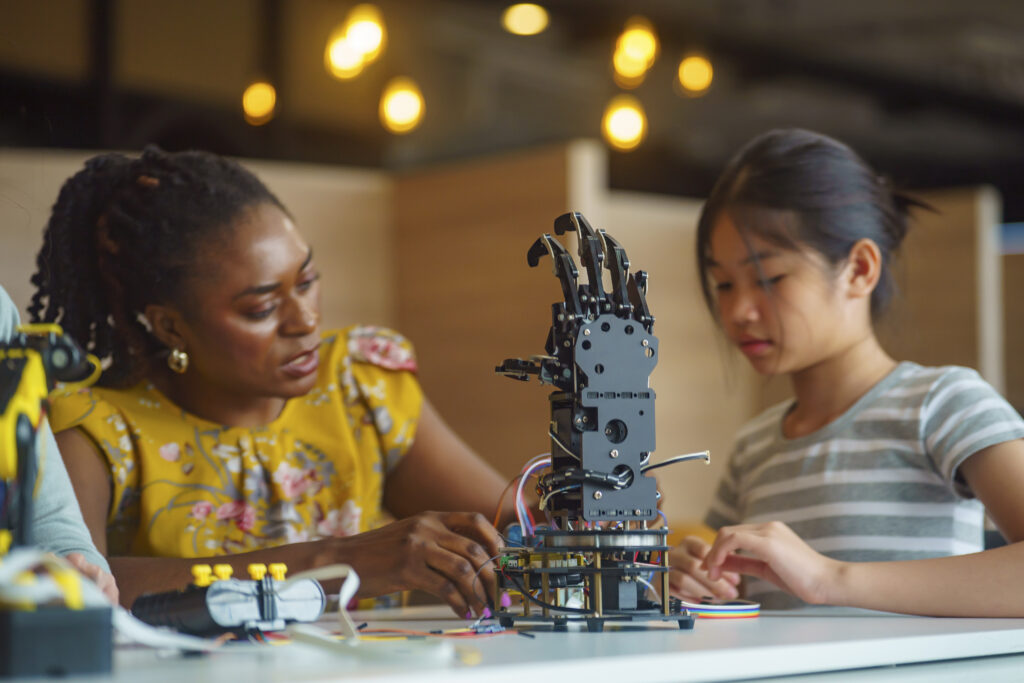
Robots can seem mysterious. Videos show machines walking, running, sorting packages, assisting surgeons, serving meals, and even carrying on conversations. To many people, the technology appears almost magical. A robot receives a command, performs a task, and somehow interacts with the world around it.
In reality, robots are not magical at all. They are complex systems made up of relatively understandable components. Whether it is a robotic vacuum, a warehouse robot, a humanoid machine, or a Mars rover, nearly every robot relies on the same fundamental building blocks.
Understanding those building blocks makes robotics far less mysterious and far more fascinating. At its core, every robot follows a simple cycle: Sense → Decide → Act → Repeat
Everything else is built around that loop.
Think fo a robot as a mechanical organism
One useful way to understand robots is to compare them to living organisms. Humans have:
- Eyes and ears to gather information
- A brain to process information
- Muscles to create movement
- A nervous system to connect everything
- A source of energy to stay alive
Robots have equivalent components.
The technologies differ, but the overall concept is surprisingly similar.
Sensors: how robots perceive the world
A robot cannot react to its environment unless it can detect what is happening around it. This is the role of sensors. Sensors collect information and convert it into data that the robot can process.
Common sensors include:
Cameras function as robotic eyes. They allow robots to recognize objects, read labels, identify people, and navigate environments. Modern AI-powered robots often rely heavily on camera systems.
Distance sensors
Many robots need to know how far away objects are. They may use LiDAR, radar, ultrasonic sensors, and infrared sensors. These technologies help robots avoid collisions and navigate safely.
Touch sensors
Some robots can detect pressure or contact. These sensors help with gripping objects, detecting impacts, and measuring force. Without touch sensors, a robot might crush a fragile object or fail to hold it securely.
Position sensors
The robot's brain: controllers and computers
Once sensor data is collected, it must be processed. This is the job of the robot’s controller. The controller acts as the robot’s brain.
Depending on the robot, this may range from a simple microcontroller to a powerful computer running advanced artificial intelligence.
The controller answers questions such as: where am I? What do my sensors detect? What task am I performing? What should I do next? Every action a robot performs originates from decisions made by its control system.
Software: the invisible component
When people picture robots, they often focus on hardware. In reality, software is just as important. The software determines how the robot moves, how it interprets sensor data, how it reacts to situations, and how it performs tasks. Without software, even the most advanced robot would be little more than an expensive sculpture.
Modern robots often contain millions of lines of code coordinating hundreds of different functions simultaneously.
Motors: the robot's muscles
Once a robot decides to perform an action, something must physically move. That responsibility belongs to motors and actuators. Motors convert electrical energy into movement.
They power wheels, arms, legs, grippers, cameras, and sensors. Every robotic motion ultimately comes from some type of actuator. The sophistication of a robot often depends heavily on the precision and reliability of these components.
Actuators: beyond simple motors
While motors are common, robots also use other forms of actuation. These include:
Electric actuators
Most modern robots use electric motors because they are efficient and relatively easy to control.
Hydraulic systems
Hydraulic actuators use fluid pressure. They are often found in heavy machinery, construction equipment, and industrial robots. Hydraulics can generate enormous force.
Pneumatic systems
Pneumatic actuators use compressed air. They are frequently used in manufacturing environments where speed and simplicity are important. Different applications require different approaches. There is no universal solution.
Control loops: the secret behind precision
One of the most important concepts in robotics is the control loop. Fortunately, the idea is simple. Imagine driving a car. You want to stay in the centre of your lane. You continuously: observe your position, compare it to where you want to be, adjust the steering wheel, and observe again.This process repeats constantly.
Robots operate in exactly the same way. A robotic arm might measure its current position, compare it to the target position, move slightly, measure again, and correct any error. This continuous cycle is called a feedback control loop. Without feedback, robots would be inaccurate and unreliable.
Why feedback matters
Consider a robotic arm trying to place a bolt into a hole. Without feedback, the arm simply guesses where to move. With feedback, the arm constantly measures its position and makes corrections. This is why industrial robots can achieve astonishing levels of precision.
Some systems can position components with accuracy measured in fractions of a millimetre. The secret is not perfect hardware. It is continuous correction.
Artificial Intelligence: an additional layer
Traditional robots rely heavily on programmed rules. Artificial intelligence adds another layer. AI helps robots recognize objects, understand speech, plan actions, learn from experience, and adapt to changing environments.
Importantly, AI does not replace sensors, motors, or control systems. It sits on top of them. You can think of AI as helping the robot decide what to do, while traditional robotics determines how to do it. Both are necessary.
Power systems: the energy challenge
Every robotic capability requires energy. Power systems are often overlooked, but they are among the most important parts of any robot.
Common power sources include rechargeable batteries, electrical connections, fuel cells, and hybrid systems. Power limitations affect operating time, weight, mobility, and performance.
One reason human beings remain difficult to replicate is energy efficiency. People can function for an entire day on the equivalent energy contained in a few meals. Many advanced robots require significantly more power to perform similar activities.
Battery technology remains one of the major constraints in robotics development.
Bringing everything together
Imagine a robot picking up a coffee mug. What appears simple actually involves numerous systems working simultaneously.
The robot must detect the mug using sensors, identify it using software, calculate its location, plan a movement path, control motors and joints, monitor grip pressure, adjust in real time, avoid collisions, and complete the task safely.
Every step requires constant communication between sensors, software, controllers, and actuators. This coordination is what makes robotics such a challenging field.
Why robotics is so difficult
Humans perform countless actions automatically. Walking across a room, opening a door, or picking up a glass feels effortless.
For robots, these activities remain remarkably complex. The challenge is not simply movement. It is combining perception, reasoning, control, and adaptation into a single system. This is why robotics sits at the intersection of engineering, computer science, Artificial intelligence, mathematics, psychology, and human factors.
Building a robot means solving problems from all of these disciplines simultaneously.
The big takeaway
Despite their complexity, most robots follow the same basic pattern. They sense the world through sensors. They process information using software and controllers. They move through motors and actuators. They continuously adjust their behaviour through feedback loops.
Everything else, from robotic vacuum cleaners to humanoid robots, is built upon these foundations.
Understanding these components makes robotics easier to understand and helps explain why building truly capable machines remains one of the most difficult engineering challenges ever attempted.