











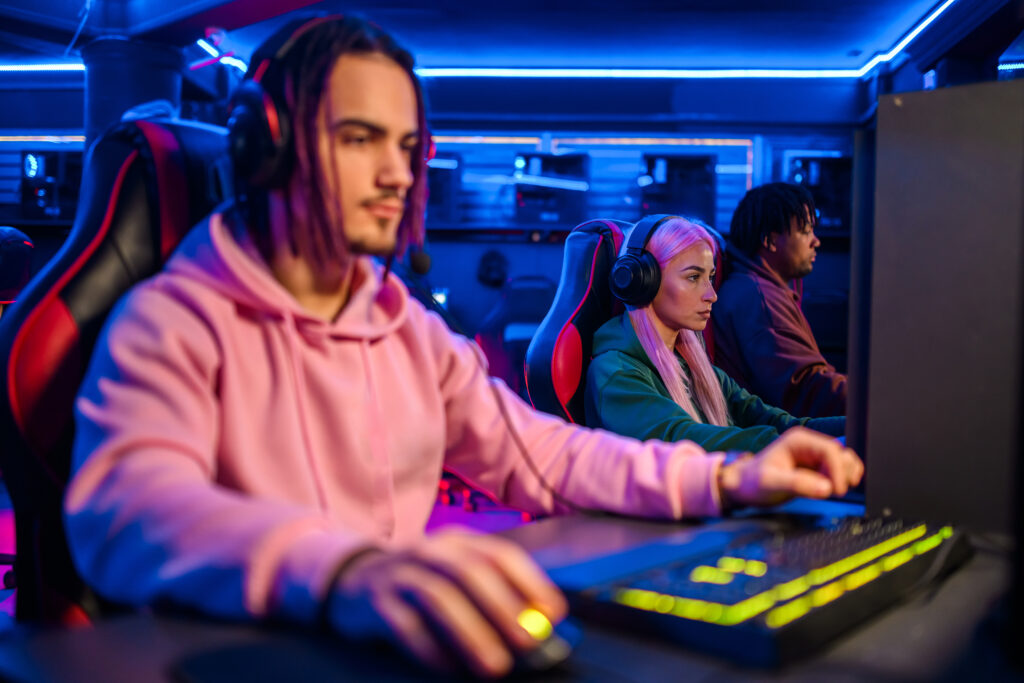
MMORPGS are online video games that blend role-playing games with massive online multiplayer features. In these games, thousands (or even millions) of players interact in a persistent virtual world, creating a parallel existence. Indeed, these virtual worlds have been studied since their inception for their fascinating sociological and psychological implications. More than that, virtual worlds offer users an opportunity to make money in a parallel economy. How does that work?
Life in a MMORPG
In an MMORPG, you can interact with players from around the world. And not just that: you can form parties, trade, and compete in real-time with them. Players assume the role of a character, curated to the minimum detail. Their character evolves with time, acquiring new skills and experience as they complete quests and challenges.
The main difference between an MMORPG and a standard video game is that in an MMORPG, the game world continues to exist and evolve even when the player is offline. Players can also socialize through live chats or marketplace exchanges.
From MUDs to MMORPGs
With the spread of personal computers in the ‘70s and ’80s, Multi-User Dungeons (MUDs) started to pop up all over the Internet. MUDs can be considered the ancestors of MMORPGs. They were text-based, multiplayer role-playing games. Players typed commands to explore, fight monsters, and talk with others. The first MUD was MUD1, created by Roy Trubshaw and Richard Bartle in 1978.
In the ‘90s, the graphical revolution moved these games from text to graphics. In 1991, AOL hosted its first graphical MMORPG, Neverwinter Nights. Not much later, Meridian 59, the first commercial 3D MMORPG, appeared. However, it was not until 1997, with Ultimate Online, that the Internet saw its first persistent world featuring player housing and whole economies. Ultimate Online had 250,000 players at its peak, making it the largest online community. In 1999, EverQuest popularized 3D MMORPGs with deep PvE content. It sparked community loyalty and the term “EverCrack” for its addictiveness.
The 2000s were the golden age of MMORPGs with RuneScape, Final Fantasy XI, World of Warcraft, and Second Life.
MMORPGs today
Today, MMORPGs have evolved into live services that support microtransactions and cross-platform play. With the advancement of technology, they are headed to metaverse-like experiences, blockchain-based MMOs with real economies and crossovers.
How do you enter a MMORPG?
To enter a MMORPG you would typically choose a game of your liking first. Popular choices today are World of Warcraft for fantasy, Star Wars: The Old Republic, for Sci-Fi, Black Desert Online or Albion Online for Sandbox games, or RuneScape and Lost Ark as free options.
Next, you must go to the official website or a trusted game platform to download and install the game client on your system. Some games may also need a launcher.
Then, you’ll need to create an account. This typically requires an email address, a username, and a password. Some games collect additional information. After you verify your account, you’ll need to pay, in some form, to launch the game and create your character. Before playing, you must join a server/region and enter a world. Only then you can start to interact with others and play the game.
The economy of a MMORPG
MMORPGs use different monetization strategies depending on their creators’ target audience and business goals. Virtual worlds typically fall into one of these models:
- Subscription-based: Players pay a recurring fee (e.g., monthly) to access the game. Example: World of Warcraft.
- Free-to-Play (F2P): The game is free to download and play, but revenue is generated through microtransactions (cosmetics, power-ups, etc.). Examples: RuneScape (modern version), Black Desert Online.
- Buy-to-Play (B2P): Players can buy the game once without ongoing fees. Some titles may have paid expansions, such as Guild Wars 2.
- Freemium / Hybrid models: Combination of free and paid features, often with subscription tiers offering bonuses. This is the case with Elder Scrolls Online.
How can users make money on an MMORPG?
Developers must earn money to create and maintain virtual worlds. However, users can also earn money from MMORPGs—sometimes legally, sometimes against the game’s terms of service (ToS).
Legitimate ways of making money from an MMORPG are:
- Streaming from content creation: using free platforms like YouTube, TikTok, or Twitch, players with charisma, storytelling skills, or PvP expertise can earn 4–5 figures monthly by share gameplay, guides, PvP matches, or roleplay sessions. The revenue comes from ads, donations, affiliate links, and sponsorships.
- In-Game Crafting & Market Flipping (with Real-Money Trading Enabled): games like Entropia Universe, Albion Online, Diablo III (historically), and Lineage Eternal allow users to farm rare items, resources, or cosmetics and sell them in game-supported real-money markets or auction houses. Some skins, pets, or gear sell for hundreds or thousands of dollars.
- Player-to-Player services: Boosting, coaching, and dungeon carries can be offered on forums, Discords, and freelancing platforms. This is often considered a grey area, as this practice might ruin the competition balance, and it may violate ToS (can lead to bans), especially if account-sharing is involved.
- Game economies with token systems: Some worlds, such as World of Warcraft (WoW Token), Runescape (Bonds), Sell in-game currency tokens (purchased with real money) for gold, then earn them through in-game grinding. The cash-out method in this case is indirect — save money on subscription or sell accounts (risky).
MMORPGs with official real-money economies
The following games allow or are structured to support real-world profit via legal in-game mechanisms:
Entropia Universe
Albion Online
Old School RuneScape
Diablo III
Altought a few MMORPGs allow users to legally make money, there’s a lot of unlawful economy pervading them. These environments hide fraud, scams, and money laundering schemes that are way more lucrative of the allowed methods to earn, at the expense of the the entire virtual world. We will explore this submerged economies and their cybercrime separately.
A note is also due on VR worlds such as Second Life and the Metaverse, where users (residents) live in a parallel world that mimicks a real economy. We will also explore these spaces, as they’re not gaming worlds per se.