











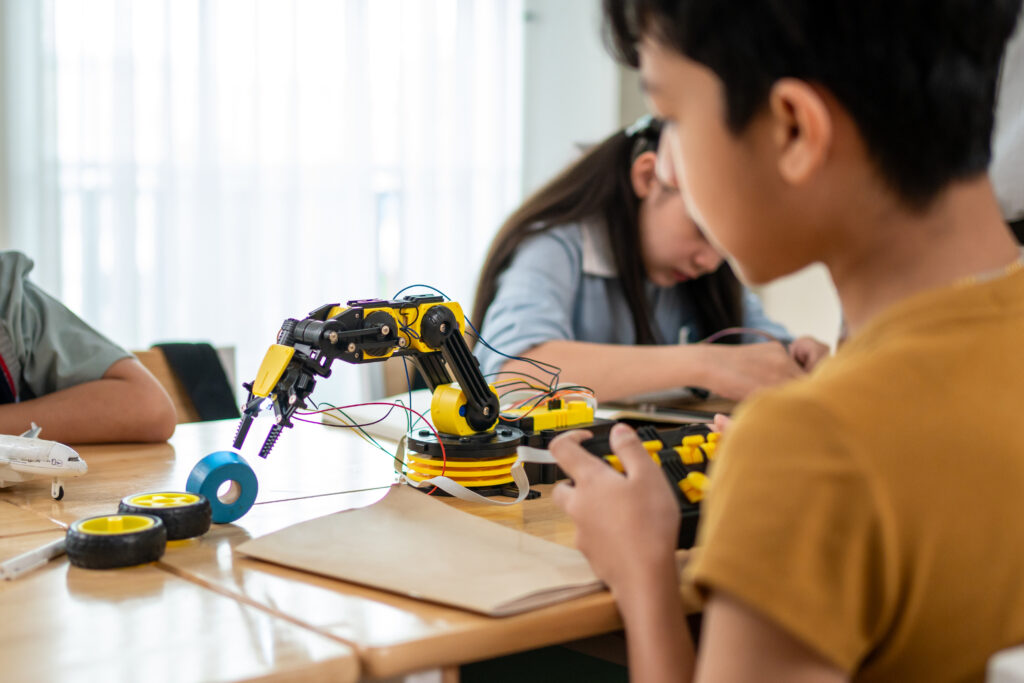
Open robotics has opened the doors to the future to anyone willing to learn. Indeed, some of the most exciting developments in robotics come from students, hobbyists, researchers, makers, and open-source communities.
Around the world, individuals are building robots in garages, classrooms, workshops, hackerspaces, and home offices using tools and technologies that would have been inaccessible only a few decades ago.
Today, a motivated enthusiast can build robots capable of navigation, object recognition, autonomous movement, and artificial intelligence using affordable hardware and freely available software.
The democratization of robotics is changing who gets to innovate. You no longer need a corporate research budget to participate.
From elite laboratories to kitchen tables
Historically, robotics was expensive. Building a robot often required specialized equipment, proprietary software, advanced manufacturing capabilities, significant funding, and access to research institutions.
As a result, robotics was largely confined to universities, governments, and major corporations. Several technological trends changed that reality.
These include:
- Affordable microcontrollers
- Open-source software
- Low-cost sensors
- Consumer-grade 3D printing
- Online learning resources
- Accessible artificial intelligence tools
Today, many robotic projects can be built for a fraction of what similar systems would have cost twenty years ago. The barrier to entry has fallen dramatically.
The open-source revolution
One of the most important developments in modern robotics has been the rise of open-source software. Rather than building every component from scratch, developers can collaborate on shared platforms and contribute improvements back to the community.
Open-source robotics offers several advantages:
- Lower development costs
- Faster innovation
- Community support
- Transparency
- Educational accessibility
This collaborative model has accelerated robotics development across academic, commercial, and hobbyist communities.
Many technologies now used in professional robotics originated within open-source ecosystems.
The role of the Open Source Robotics Foundation
One organization has played a particularly important role in shaping modern robotics. The Open Source Robotics Foundation was established to support the development, distribution, and adoption of open-source robotics software.
Its mission has been simple but transformative: make advanced robotics tools available to everyone.
Rather than restricting access to proprietary technologies, the organization helped foster a global community of developers, researchers, educators, and enthusiasts. The impact of this approach can be seen throughout the robotics industry today.
Many commercial robotic systems rely on technologies that originated within open-source projects.
ROS: the operating system for robots
No discussion of open robotics would be complete without mentioning the Robot Operating System, commonly known as ROS.
Despite its name, ROS is not a traditional operating system. Instead, it functions as a software framework that helps robotic components communicate and work together. Think of ROS as a toolkit that provides common building blocks for robotics development. It helps developers avoid reinventing the wheel every time they build a robot.
ROS provides tools for:
- Sensor integration
- Navigation
- Mapping
- Motion planning
- Communication
- Simulation
- Visualization
By using ROS, developers can focus on solving specific problems rather than building fundamental infrastructure from scratch. This has made robotics development significantly more accessible.
Why ROS became so popular
Before ROS, robotics development often involved creating custom software for nearly every project. This approach was expensive, time-consuming, and difficult to maintain.
ROS introduced a more modular approach. Developers could reuse existing components, share software packages, build upon community contributions, and collaborate across organizations. The result was a rapidly growing ecosystem of tools, tutorials, and reusable software.
Today, ROS is widely used by universities, research laboratories, startups, industrial robotics companies, and hobbyists alike. Its influence on modern robotics is difficult to overstate.
Simulation: breaking things without breaking anything
One of the biggest challenges in robotics is testing. Building physical prototypes can be expensive and time-consuming. Simulation environments allow developers to experiment safely before deploying real hardware.
Modern robotics simulations can model sensors, motors, physics, terrain, obstacles, and even environmental conditions. Developers can test ideas, identify problems, and refine behaviours without risking equipment damage.
This capability has become especially valuable for students and hobbyists working with limited budgets.
Affordable hardware changes everything
Software alone is not enough. Fortunately, hardware has become dramatically more accessible.
Popular platforms include:
- Arduino microcontrollers
- Raspberry Pi computers
- Affordable LiDAR systems
- Camera modules
- Servo motors
- Open-source robotics kits
Many components that once cost thousands of dollars are now available for a small fraction of their historical price. As manufacturing scales and technology matures, affordability continues to improve. This trend has helped create a global community of builders experimenting with robotics from home.
The maker movement and robotics
The maker movement has become closely linked with robotics. Makers combine electronics, software, fabrication, and creativity to build custom solutions.
Projects range from simple educational robots to surprisingly sophisticated autonomous systems.
Common DIY robotics projects include:
- Line-following robots
- Autonomous vehicles
- Robotic arms
- Home automation systems
- Environmental monitoring platforms
- Educational robots
Many enthusiasts begin with small projects and gradually develop skills that lead to professional opportunities in engineering, cybersecurity, or software development. For many people, robotics serves as an entry point into broader technical careers.
Learning robotics has never been easier
One of the most remarkable changes in recent years is the availability of educational resources. A student interested in robotics can now access free online courses, video tutorials, open-source documentation, community forums, research papers, and public code repositories. Knowledge that was once restricted to specialized institutions is now widely available.
While robotics remains a challenging field, learning pathways are far more accessible than they were in the past. Curiosity often matters more than formal credentials.
Open robotics and innovation
Open ecosystems have historically driven innovation across many areas of technology. The internet, Linux, web technologies, and numerous programming languages all benefited from collaborative development models.
Robotics appears to be following a similar path. Open-source projects allow experimentation at a scale that would be difficult for any single organization to achieve. Thousands of contributors working independently can collectively explore ideas, identify problems, and develop solutions.
The result is often faster innovation and broader participation.
The security challenge
Open robotics also introduces security considerations. The same openness that encourages collaboration can create risks.
Developers must consider software vulnerabilities, supply chain risks, dependency management, secure coding practices, and access controls. As open-source robotics becomes more common in commercial and industrial environments, cybersecurity becomes increasingly important.
Organizations adopting open technologies must balance accessibility with security. Fortunately, transparency often makes vulnerabilities easier to identify and address.
From a hobby to a career
It is tempting to view hobbyist robotics as separate from the professional robotics industry. History suggests otherwise.
Many major innovations originate from communities experimenting outside traditional corporate environments. Open-source projects frequently influence commercial products. Students become entrepreneurs. Garage projects become startups. Research prototypes become industry standards.
The accessibility of robotics ensures that innovation can come from almost anywhere. That diversity of ideas may be one of the field’s greatest strengths.
The future is more accessible than ever
The future of robotics will not be built exclusively by multinational corporations or government laboratories. It will also be shaped by students, makers, researchers, hobbyists, educators, and open-source contributors working around the world.
Affordable hardware, powerful software frameworks, artificial intelligence, and collaborative communities have lowered barriers that once seemed insurmountable.
Building robots remains challenging, but it has never been more accessible. For anyone curious about robotics, there has never been a better time to start experimenting. The next breakthrough might emerge from a university laboratory, a startup incubator, or a workbench in someone’s garage.
Increasingly, all three are part of the same ecosystem.